Friday, November 12, 2010

The Unseen #50: The Sundowners


Why’d I Buy It?: Came In Robert Mitchum Box set I bought.

Why Haven’t I Watched It?: Not a huge Fred Zinneman fan, hadn’t really heard that much about it. But I figured a Robert Mitchum Movie would be the perfect way to celebrate reaching fifty entries in The Unseen.

How Was It?: The Sundowners is one of the most laid back epics ever made. Most films of its era and size rush along in a panic of spectacle, desperate to prove film relevant in the face of Television. Predicated on incident rather than event. The Sundowners takes the opposite route. It’s probably the closest thing we’ll ever come to an old school Hollywood epic directed by Richard Linklater.

The Sundowners follows a family of Sundowners (Australian slang for vagabonds) follow job to job around the country, droving sheep across The Outback. The family is headed up by Robert Mitchum, as always a personification of charisma and cool and the film is lucky enough to be one of the four he did with Deborah Kerr, one of the few women who always seemed able to match him. Rounding out the cast is the incomparably fussy Peter Ustinov as their family friend/sidekick. As always Ustinov happily more or less plays himself. And as always he does so as if there would be no one else who could possibly be more delightful to play.

(Wait... Wut?)

Rather then allowing some artificial crisis, obscure these characters Zinneman pulls back and simply lets us enjoy them.

The conflict such as it is, comes from the desire of Kerr to settle down with her son and Mitchum’s desire to push forever on into the horizon. Still this isn’t handled melodramatically, but with a fairly surprising amount of realism for the time. There are no real histrionics, just another at odds married couple trying to work shit out.

I’ve never been a huge fan of director Frederic Zinneman (though I do admire his A Man For All Seasons) but he directs well here. With a keen unshowy visual eye, a sure hand with the set pieces the film does have (A scene where the family is caught in a forest fire with their flock being the most impressive, with some truly striking imagery) and a judicious use of the local color. The Australian setting adds a well employed sense of the exotic, and some beautiful shot on location footage which captures both the beauty and the harshness of the land. It also presents the opportunity for some of the worst faux Australian accents known to man.

The Sundowners at the end of the day may not remake the wheel. Call it workman like if you must. What it does is present an engaging, entertaining, occasionally wistful and pleasantly human story, with one of the greatest movie stars of all time at its center. Sometimes you just need a good movie to curl up to on a lazy Sunday afternoon and for the classic movie fan The Sundowners fits that bill admirably.

Wednesday, November 10, 2010

Scenes #1: Pan's Labyrinth

Today I’m starting a new column on Things That Don’t Suck. It’s one I’ve wanted to do for a long time, at least since the piece I did in the same format on The Prestige. Sometimes when we’re watching a movie, regardless of the greatness or lack there of as the film as a whole. It’s a single scene that rattles around in the mind.

A quick note about what Scenes ISN’T. It’s not going to be a shot by shot look at the scene. Though I have no doubt that some entries will demand just that. Nor is it going to be the kind of purely visual essay that you find done so well at Moon In The Gutter or Shock Of Glimpsing.

Instead Scenes is going to be about looking closer. I truly do believe that a lot of what makes a film work is intangible. Scenes is about what happens when I’m in the opposite mood. It is simply a closer look.

Needless to say, there will be spoilers.

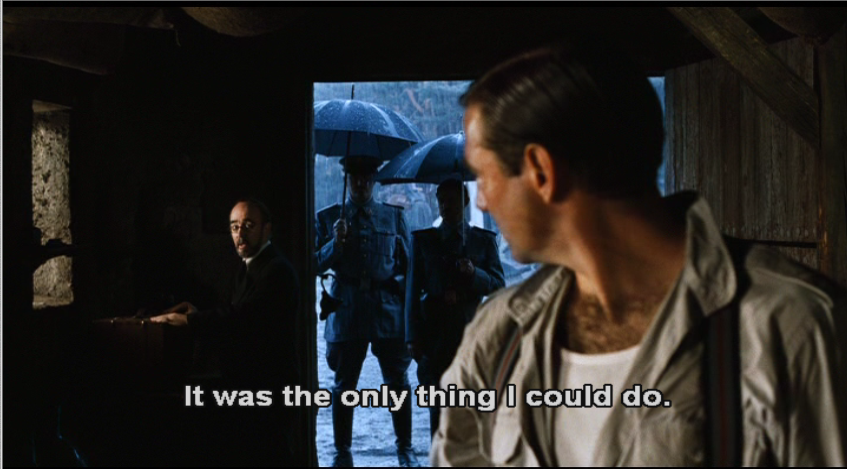
The scene in Pan's Labyrinth needs a little bit of setting up. A few scenes before the one I want to discuss, the runt of the Spanish resistance fighters has been captured by Captain Vidal and now lays at his mercy. We know, though the captain doesn't that the boy has the power to not merely compromise the Spanish resistance forces, but several of his own staff as well, including his head of household, and doctor.


By the time we reach the end of the scene, capped off when the Captain offers the stuttering boy his freedom if he can count to three without stammering, perhaps the most sadistic thing in Del Toro's oeuvre, it is clear to us that the Captain is a genuine monster.

A few scenes pass, following our lead Olivia, allowing plenty of dread to build off camera before we return to that dusty barn. This time with the doctor himself in tow.


It's classic tension building stuff. Has the man talked? Has the doctor been compromised?

There's still no sure answer.


But note the graceful juxtaposition between his toolbox and Vidal's.


We get our first full look at the damage done by Vidal.


While Vidal himself discovers the Doctor's true loyalties. The Doctor didn't walk into a deathtrap but he's in one now.

Crucially, the doctor does not see Vidal discover the clue. His act of courage here is not that of a desperate man with no way out, but one who believes he COULD still walk away unscathed. If he so chose.


Until this happens. Even if Vidal wasn't suspicous it's doubtful the Doctor could have gotten away with walking out of the building with a shrug and a "Woopsy daisy your crucial informant died." To put the man out of his misery he must doom himself, and he knows it.

Rack Focus...


Matched To Rack Focus...


The Doctor hesitates...


Then Does what he must.


The Captain returns after spreading his monstrosity to the fantasy world, burning the mandrake root in one of the film's most disturbing images. In short order he discovers the treachery, and poses the question.


After the doctor's answer The Captain retorts that The Doctor "Could have obeyed him." To which the doctor replies "That only people like the Captain can do that."

That's optimistic to the point of being a lie. Just ask the country of Germany circa 1938, or the soldier's headed to My Lai, or stationed at Abu Ghraib. If history has documented one thing rather conclusively, it is that ordinary people will do horrific things with remarkably little compunction.

Yet here he is, this small fastidious little man, not the dashing rebel leader, not the chosen one, who has the courage to do what he knows he must. Knowing there is no hope of escape, knowing the cost he must pay. Brave enough to do it anyway.


And pay for it he does.

In explaining the film Del Toro quoted Kierkegaard when he said "The Reign of the Tyrant ends in death. The Reign of the Martyr begins in it." The Doctor is vindicated, not merely in the death of the tyrant, but in the righteousness of the act itself.

In a film full of mythical power, this is one that falls straight in the realm of the physical. And yet there has not been a scene I've watched before or since, has made me question my own morality and courage quite so much.

The 25: Part 18: Ghost In The Shell


(The twenty five is an examination of the twenty five films that made me a cinephile. These aren’t necessarily what I consider the best movies, nor are they necessarily my favorite. Though in some cases they are both. Instead these are the films that made the biggest most indenialable impression on me. Films that if they hadn’t hit a certain way at a certain time I would not be the same film goer that I am today. They’re the twenty five.)


“Incorrect I am not an AI. My code name is Project 62501. I am a living thinking entity who was created in the sea of information.”


-Ghost In The Shell-

I assure you that shit blew my mind back in the day.

Some movies stick in the mind just by virtue of getting there first. Had been I exposed to the idea’s of replication and the implications it has in terms of identity, particularly in the digital era, by William Gibson, Stanley Kubrick, Phillip K. Dick, Neal Stevenson, or hell even Steven Spielberg first, I may have not reacted so strongly. But the fact is that Ghost In The Shell DID get there first, and those ideas DID connect with me on a very primal level. Shaping not so much the way I view the world as the questions I wanted to ask about it.

But it didn’t just affect my ideas about life, but filmmaking and genre. Ghost In The Shell transcended the ideas of genre as thoroughly as Katsuragi and The Puppet Master transcended the ideas of consciousness. Ghost In The Shell taught me Genre has upon it only the limitations the creator’s of it, and you as a viewer set. You’re restricted only by the story you tell and the strength of the metaphor you create.

Ghost In The Shell tells the story of a government black operative who is caught up in a battle between dueling government agencies to control, contain or destroy an entity called The Puppet Master. A sapient being that spontaneously generated from “The Sea Of Information.”

What is truly amazing is how prescient and fresh Ghost In The Shell still feels fifteen years later . Both in style and ideas. Like William Gibson our world has simply caught up to it.

The film is in a sense built around two set pieces, a chase through and gun battle in, a crowded Farmer’s Market that creates a future world as vivid, believable, and immersive as any I’ve ever seen. A sprawl where people seem to actually live, rather then a simple Neon Depository. All this while delivering a running gun battle worthy of Woo at his very best, which makes good use of the rules and physics of the world it has established (note the metal roof crumpling under the weight of The Major's cybernetic body).


(I've always loved this insert shot of the assassin bracing himself with his foot before opening fire. Such a small detail but adds so much realism and danger)


The other involves a long dreamy montage at the center of the film. At the center of which comes this series of shots.


The above series of shots is engaging because we don’t know how literarily we are supposed to take it. Is the sight just a consequence of the heroine’s disconnected fugue state, or is this the ultimate result of the cheapening of identity that this film prophesied and the digital era promises. It’s worth noting that Joss Whedon won plenty of accolades for essentially copying this film’s technology and moral debates verbatim.

This is a more visual piece then I’m usually do, if only because the movie’s strength’s rest so strongly in them. And I’m not simply talking about empty style, but the communicativeness of the images. This pathetic lost look of dawning incomprehension, the look of the damned, on the ghost hacked would be assassin, as he realizes just how little he knows about “himself” is worth a thousand wordy monologues about how fragile a construct identity is.


And I happen to know this because Ghost In The Shell actually does contain a thousand wordy monologues on that subject.

And here lies the rub for a lot of people with this movie. Ghost In The Shell plays long for a movie that just barely cracks the eighty minute barrier with the help of two long credit sequences. Personally I mean that in a good way. It’s a hallmark of Mamoru Oshii as a filmmaker that he takes his damn sweet time when it comes to pace. And for me his meditative evocative montages are highly affecting. The above montage has a “sister” of sort late in the film just before the climax that focuses on what are basically the action sci fi equivalent of pillow shots accompanied by a low atonal guitar. A striking moment of quiet before the gruesome finale that I always find beautiful and haunting.

Unfortunately long didactic monologues are also a trademark of Oshii which means that the film is filled with shots of the characters staring directly into the screen, delivering paragraphs of dialogue that seem like the result of an epic night of brainstorming between Hideaki Anno and Lana Wakowski.

Speeches like this...

"There are countless ingredients that make up the human body and mind, like all the components that make up me as an individual with my own personality. Sure I have a face and voice to distinguish myself from others, but my thoughts and memories are unique only to me, and I carry a sense of my own destiny. Each of those things are just a small part of it. I collect information to use in my own way. All of that blends to create a mixture that forms me and gives rise to my conscience. I feel confined, only free to expand myself within boundaries."


-Delivered in a single uninterrupted breath by an actor who only seem to vaguely comprehend what she’s saying cannot help but come off as Hokey. Some of the problem probably stems from me watching The American Dub (I’m normally a sub purist but considering that the dub was the version I watched and rewatched after taping it off of The Action Channel at fourteen it seems only fair) But all the blame can’t be put on the dubbing. A pedantic ranting monologue by any name…

It must also be admitted that narrative clarity has also never been Oshii’s strong suite. And Ghost In The Shell is no exception. Oshii is splendid at communicating his idea’s and action visually, but not his stories. True the task of condensing a long running manga series into seventy five minutes is never easy. But it might have been wise for Oshii to not place quite so much emphasis in the plot on the cloak and daggering of fictional bureaucracies whose function and relationship to each other are vague at best. It also carries with it (as those who have seen the above wildly unrepresentative poster that began the article) that special tang of gender confusion that only anime can have. The kind that makes The Major genuinely one of the most well rounded, capable, and interesting female characters in Science Fiction and yet has to strip down to her lovingly detailed skivvies whenever she wants to use her technology.

Still if the film is overly earnest in its ideas it is only because it is so obviously taken with them. The vibrancy of the world and the radicalness of its concepts and ambition won me over such petty flaws then, and they do anew each time I rewatch Ghost In The Shell.

Tuesday, November 9, 2010

Mea Culpa


Sorry for the slight lull. The day break I intended to take to recharge my batteries after 31 Days abruptly morphed into this when two long (and I do mean loooonnnggg) pieces collapsed after failing to cohere into anything anyone would ever be interesting in reading ever.

There was much gnashing of teeth over wasted effort, and cajoling and curses, but it was all to no avail.

Anyway this is my roundabout way of saying we should be back to your regularly scheduled programming either later today or early tomorrow.

Thanks for the patience.