Jack London In Paradise, Paul Malmont
Sunnyside, Glen David Gold
The Illustrated Man, Ray Bradburry
The Jugger, Richard Stark
Hero Type, Lyga
Ghostopolis, Tommysauraus Rex, Black Cherry, Doug TenNapel
Scott Pilgrim Vol 6, Bryan Lee O'Malley
Heretics, GK Chesterton
(If you are Paul Malmont or his Mother you may want to not read this review.)


Of Frank Sinatra, Bing Crosby famously quipped “There’s a genius born into every generation. But why did HE have to be born into mine?” Its hard to believe that those words don’t echo around Paul Mamount’s head everytime he reads a glowing notice about Glen David Gold.
Both walk the same beat. "Carter Beats The Devil" and "The Chinatown Death Cloud Peril", their respective debuts both studied the effect of pulp heroes at the dawn and death of the thirties. And their second novels released within months of each other both explore the effect of a major cult of personality studied against the looming advent of World War I, and the dawn of film as an artform. Both even use Griffith’s Intolerance as a point of reference.
The difference of course is that Gold is arguably a genius. "Sunnyside" is a marvelous book. Big, sprawling, and generous of heart. Written with a dexterity and wit of a truly great prose stylist, and the panache of a born storyteller. Meanwhile Paul Malmont strives towards adequacy.
I’ll say this in advance this will be a crueler review then is perhaps expected from me. And I’m sorry for it. While I might not care much for Malmont’s work thus far, I stubbornly like him. Any man who would write a mystery to be solved by The creators of Doc Savage and The Shadow, with help from HP Lovecraft, Louis Lamour, and El Ron Hubbard, is a man who I cannot help but feel simpatico with on a very deep level. Still, the fact that his reach extends his grasp so thoroughly time and again is just frustrating.
For starters he just makes some baffling narrative decisions. He overloaded "Chinatown" to the point of collapse in its final hundred pages. Here the problem is a bit harder to quantify. "Jack London in Paradise" starts off by following a producer director as he tracks London to Hawaii in the hopes of securing an original screenplay from him that will save his studio.
While harldy engrossing this is at least an understandable device. By the time we finally meet London a hundred pages in, Malmont has built up a real feeling of anticipation, and even dread into the unseen figure. What’s baffling is that after London appears, and we follow him for the meat (and admittedly pretty damn good) section of his story, we then switch back to Boswarth for a hundred pages of denounemet that we as readers could care less about. It is one thing to be kept out of the main event in order to build a sense of drama, its another to be senselessly tossed out again at the climax of the story.
All of this could be forgiven as merely clumsy, but what really cripples the book is the thorough Whitewash performed on London’s character. While Sunnyside is relentlessly warts and all and then more warts. Gold ends up making Chaplin all the more engrossing and lovable for it, "Jack London In Paradise" goes out of its way to avoid anything about London that was controversial. Which takes some doing.
Oh sure it mentions his love of socialism, his feelings on free love, and nietzche and all the other things that makes him oh so compatible with modern sensibilities. But it ignores his racism and imperialism, WHILE BRINGING UP THE VERY INCIDENTS THAT MADE THESE TRAITS SO VERY WELL KNOWN.
For example, they mention in passing him going to watch Jack Johnson box. And yet neglect to mention that while he was doing so he was busy writing some of the most virulently racist prose we have on record. That he invented the phrase “The Great White Hope” and spent the enterity of his writings begging Jim Jefferies to come out of retirement and “Beat the uppity something something.” We’re supposed to be very moved with the relationship that London has with his Japanese houseboy (really), which I suppose we would be, had Jack London not, you know, invented the fucking “Yellow Peril” (http://www.readbookonline.net/read/298/8662/).
Which begs the question does Malmont think his readers stupid to wrap their head around such contradictions? Or merely too ignorant to know about them? Is he not aware of the invention of wikipedia?
No one is claiming that London wasn’t a fantastic writer, or that his work should be discounted or ignored because of his ignorance. You can take him off my shelves after you’ve pryed Lovecraft and Kipling from my cold dead hands. In fact its that exact Frission between the nobleness of some of London’s ideas and most all of his writing and the sheer stupidity of some of his views, that makes London such a fascinating read even today.
By ignoring that frisson Malmont has turned in a book that can only be described as cowardly. And for all his many flaws, that was something London never was.

Man I love Barry Lyga. Like SE Hinton for geeks. Lyga has a laser citing on a particular wavelength of emotional hysteria that can be adolescence.
With a great voice, eye for character and detail, and stealth skill as an expert plotter, Lyga keeps churning out these painfully honest, emotionially generous, drop dead funny stories.
Following a young boy who inadvertandly becomes a free speech advocate when a meaningless gesture earns him the ire of the town he lives in. "Hero Type" somehow manages to not get caught up in its didactism (Hullo Cory Doctrow) or its melodrama. Instead using the grander arc as a counterpoint to a very moving story of a young man facing his dark side.
Barry Lyga writes clearly and honestly about the time in life that it is absolutely easiest to be muddled and false about. He does what he does very well, and is an author worth celebrating.
…

"The Jugger", the sixth Parker novel, shakes things up by placing Parker in a situation that he not only didn’t create, but doesn’t fully comprehend. In short order Parker is forced to be a sleuth.
Only problem is Parker doesn’t have a lot of sleuthing in his nature. And when he gets tired of trying to figure out what the hell is going on, he just starts killing his way out. Things get very messy very quickly.
Like all of the Parker books, Starks bone hard prose and plotting turn it into a propulsive read, and the pitch black humor evident in "The Mourner" rears its head here again (Note the perfect revelation, that Parker showed up in town not to help someone as we foolishly presumed, but to kill him.)
Still as much as I enjoyed the Parker novels, they seemed be getting a little formula bound. Apparently Westlake agreed. And after shaking things up a little in "The Score", and a lot here, he promises in the climax an even more radical change of the status quo. It’ll be interesting to see how he does. I have a feeling the next few books will be very good reads.
…

Bradburry is an author I’ve only been able to appriciate over time. His overly lyrical writing annoyed me when I was younger, obscuring his wonderful stories. But a "The Illustrated Man" makes a great reentry point into Bradburry’s world.
As with most short story collections its difficult to evaluate as a whole. Some of his stories showcase him at his didactic worse. Others, like The Veldt, more relevant then ever today, show him at his sharpest. I still may not always know what I’m getting into with Bradbury, but more often then not I find it rewarding.
…
"It is foolish, generally speaking, for a philosopher to set fire to another philosopher in Smithfield Market because they do not agree in their theory of the universe. That was done very frequently in the last decadence of the Middle Ages, and it failed altogether in its object. But there is one thing that is infinitely more absurd and unpractical than burning a man for his philosophy. This is the habit of saying that his philosophy does not matter, and this is done universally in the twentieth century, in the decadence of the great revolutionary period."

As with most short story collections its difficult to evaluate as a whole. Some of his stories showcase him at his didactic worse. Others, like The Veldt, more relevant then ever today, show him at his sharpest. I still may not always know what I’m getting into with Bradbury, but more often then not I find it rewarding.
…
"It is foolish, generally speaking, for a philosopher to set fire to another philosopher in Smithfield Market because they do not agree in their theory of the universe. That was done very frequently in the last decadence of the Middle Ages, and it failed altogether in its object. But there is one thing that is infinitely more absurd and unpractical than burning a man for his philosophy. This is the habit of saying that his philosophy does not matter, and this is done universally in the twentieth century, in the decadence of the great revolutionary period."
(Pimp Daddy)
"Heretics". Its Chesteron. You know the drill by now. He says some things that are among the wisest, funniest, most humane sentiments I’ve seen layed down in prose. And others that are consequences of the time he was in. Which is a euphimism for, shit that is kind of ignorant.
Still I don’t know an author other then Chesterton whose lapses I more eagerly forgive. Heretics, as it’s a direct response to some of his other work, and as it depends upon a working knowledge of 19th century English politics and literature (w00t) is hardly an ideal entry point for Chesterton. But for the admirer it’s a rewarding piece of work.
...
Oh then there was this.
...


As some of you might recall, earlier in the month I reviewed "Ghostopolis". I liked it. A lot.
Afterward craving more TeNapel I picked up two books of his I haven’t read, "Black Cherry" and "Tommy Sauraus Rex."
Black Cherry is the first TenNapel book I’ve read that doesn’t quite work. Don’t get me wrong, its got wit, verve, and personality to spare. And if I didn’t know what TenNapel was capable of I’d probably like it a whole lot more. But…
Its basically Doug TenNapel’s Sin City, with the naughty Catholic School sixth grader energy moved from the libido to the intellect with all its irreverence intact. With all the good and bad that it implies. But Doug TenNapel is not Frank Miller. And at times Black Cherry uncomfortably resembles watching your Dad try to talk “street” Lets just say I didn’t know anyone not named Hank Venture used the word “Honky” unironically anymore.
There are other weird problems, like the over abundance of gay slurs. TenNapel writes a note about the language of the book in the beginning, and he makes some valid points. But it comes to a point that’s nearly tourettes. It just gets distracting.
The place TenNapel stumbles that I didn’t expect is in the theological material. Its not that he didn’t come up with interesting stuff. He always does. But that he chooses to center his story around the conversion of his characters.
Now once again, this is something that TenNapel is really good at. Creature Tech for example is one of the most moving conversion stories I’ve ever read thanks to the way it methodically shows the characters progression. But in Black Cherry the characters are being chased by Demons. Demons Who are always talking about their deeds and goals in theological terms. Demons who are couching their discussions about God in the terms of personal acquaintance. Demons who are being defeated by Holy Water. There’s also the occasional intercession from Angels. Now look, I’m a doubting Thomas by nature. But even I have to think that my inherent skepitism would wither under a full frontal assault from the legions of hell. When late in a the book a character remarks that the “only God she believes in is the one that goes in her arm.” It was all I could do to keep from shouting “COME ON!”
Still for all it’s flaws I still really enjoyed Black Cherry. It’s got some great moments, including a killer bit where a doomed mobster tries to ward off a demon by saying “I believe in the power of the Catholic Church.” To which the demon quips “Well so do I.” One has to give credit to TenNapel for writing a book, that as he points out in his introduction, no one in any quadrent of his fanbase would conceivably want him to write. That ability to push himself, is thankfully a tenant of TenNapel. And it does him credit, even when the final product doesn’t quite come together.
Tommy Sauraus Rex on the other hand finds TenNapel right in his sweet spot. Telling a wistfully weird story of an eight year old boy who gets to live the dream of every eight year old boy and receives a sentient T-Rex as a pet.
It might not be as perfectly entertaining as the likes of Monster Zoo and Iron West. But its damn good, and has more imagination and honesty in it then 98% of “children’s” literature out there.
Its TenNapel’s most secular work, so if you’ve been worried about that being a stumbling block to TenNapel this is a perfect place to begin. And it’s not as willfully strange as some of his other work. Though it’s still idiosyncratic enough to include a cameo from the great Ray Harryhausen.
Both may not be TenNapel’s greatest work, but both illustrate that even second tier TenNapel is simply wonderful.
Still I don’t know an author other then Chesterton whose lapses I more eagerly forgive. Heretics, as it’s a direct response to some of his other work, and as it depends upon a working knowledge of 19th century English politics and literature (w00t) is hardly an ideal entry point for Chesterton. But for the admirer it’s a rewarding piece of work.
...
Oh then there was this.
...


As some of you might recall, earlier in the month I reviewed "Ghostopolis". I liked it. A lot.
Afterward craving more TeNapel I picked up two books of his I haven’t read, "Black Cherry" and "Tommy Sauraus Rex."
Black Cherry is the first TenNapel book I’ve read that doesn’t quite work. Don’t get me wrong, its got wit, verve, and personality to spare. And if I didn’t know what TenNapel was capable of I’d probably like it a whole lot more. But…
Its basically Doug TenNapel’s Sin City, with the naughty Catholic School sixth grader energy moved from the libido to the intellect with all its irreverence intact. With all the good and bad that it implies. But Doug TenNapel is not Frank Miller. And at times Black Cherry uncomfortably resembles watching your Dad try to talk “street” Lets just say I didn’t know anyone not named Hank Venture used the word “Honky” unironically anymore.
There are other weird problems, like the over abundance of gay slurs. TenNapel writes a note about the language of the book in the beginning, and he makes some valid points. But it comes to a point that’s nearly tourettes. It just gets distracting.
The place TenNapel stumbles that I didn’t expect is in the theological material. Its not that he didn’t come up with interesting stuff. He always does. But that he chooses to center his story around the conversion of his characters.
Now once again, this is something that TenNapel is really good at. Creature Tech for example is one of the most moving conversion stories I’ve ever read thanks to the way it methodically shows the characters progression. But in Black Cherry the characters are being chased by Demons. Demons Who are always talking about their deeds and goals in theological terms. Demons who are couching their discussions about God in the terms of personal acquaintance. Demons who are being defeated by Holy Water. There’s also the occasional intercession from Angels. Now look, I’m a doubting Thomas by nature. But even I have to think that my inherent skepitism would wither under a full frontal assault from the legions of hell. When late in a the book a character remarks that the “only God she believes in is the one that goes in her arm.” It was all I could do to keep from shouting “COME ON!”
Still for all it’s flaws I still really enjoyed Black Cherry. It’s got some great moments, including a killer bit where a doomed mobster tries to ward off a demon by saying “I believe in the power of the Catholic Church.” To which the demon quips “Well so do I.” One has to give credit to TenNapel for writing a book, that as he points out in his introduction, no one in any quadrent of his fanbase would conceivably want him to write. That ability to push himself, is thankfully a tenant of TenNapel. And it does him credit, even when the final product doesn’t quite come together.
Tommy Sauraus Rex on the other hand finds TenNapel right in his sweet spot. Telling a wistfully weird story of an eight year old boy who gets to live the dream of every eight year old boy and receives a sentient T-Rex as a pet.
It might not be as perfectly entertaining as the likes of Monster Zoo and Iron West. But its damn good, and has more imagination and honesty in it then 98% of “children’s” literature out there.
Its TenNapel’s most secular work, so if you’ve been worried about that being a stumbling block to TenNapel this is a perfect place to begin. And it’s not as willfully strange as some of his other work. Though it’s still idiosyncratic enough to include a cameo from the great Ray Harryhausen.
Both may not be TenNapel’s greatest work, but both illustrate that even second tier TenNapel is simply wonderful.


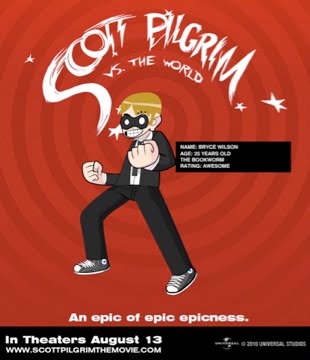


 Where the hell to even start?
 Lets face it, a lot of Scott Pilgrim is just plain lifestyle porn. Illustrating the kind of twenties that nobody ever quite has and everybody wants.












 Posts
Posts


