
George Romero defined the zombie film. And in that he perhaps did his job too well.
Very few zombie movies, hell zombie works in any medium, have pushed past Romero’s films, either narratively, stylistically, or thematically. The greatest deviation from the text thus far being the staggering idea, “Well what if the zombies… were like… fast?”
Virtually all Zombie movies end at the same point, with the last vestiges of civilization crumbling and our remaining heroes (if any there be) running off into the wilderness. (Two major exceptions being Danny Boyle’s nominally happy ending to 28 Days Later. Which along with Shaun Of The Dead tell me that though Brits might be cynical about a lot things, their trust in their government's ability to handle an outbreak of zombies is absolute). And Romero’s own criminally underrated Land Of The Dead. Some would argue that Dawn Of the Dead qualifies, but the mall is so insular I don’t think it counts. Had the film followed the bikers, then sure.) Were they go from there and what happens next has not been a question filmmakers have been particularly interested in asking.
Even movies like 28 Weeks Later which pointedly take place in the aftermath of a zombie disaster seem more or less dedicated to taking things to square one.
In the word’s of Henry Jones Sr. “They leave just as they’re getting interesting.”
There is of course one major exception to this rule, which would be Robert Kirkman’s The Walking Dead. The secret to Kirkman’s Zombie opus, now Frank Darabont’s as well, is that it’s not really about Zombies at all. Though it makes fantastic use of them they’re really just one hell of a macguffin. The book could be about anything that forces society to rebuild itself. One suspects that Kirkman could have written his book about the aftermath of a plague, or a war, or an alien invasion. It’s all about the interruption of societies continuity. And what happens afterwards.
Or as Kirkman himself so succinctly put it on the back of each Walking Dead trade.
“When is the last time any of us really worked to get something we wanted?
How Long as it been since any of us really Needed something that we wanted?
The world we knew is gone. The world of commerce and frivolous necessisty has been replaced by a world of survival and responsibility. In a matter of months society has crumbled. No government. No grocery stores. No mail. No cable TV. In a rule ruled by the dead we are forced to finally start living.”
That last line may be a bit on the nose. But there is simply no escaping the fact that Kirkman’s underlying message is that mankind would be much better off with a 99% of it’s trivial bullshit mercilessly and completely swept away.
And he makes a compelling case, despite the parade of horrors he’s shown.
Romero, who always tied his ghouls into specific aspects of social satire (Racism, Consumerism, Militarism, Neo Cons, Social Media Solipsism, the er Irish?) never came as close to obliterating the system in it’s totality.
This is in all fairness at least partially due to the fact that Romero had to tell his story in two hour chunks, while Kirkman has the luxury of at this point literally thousands and thousands of pages.
I’m certainly, not meaning to dig at Romero, who I admire immensely as a filmmaker, and not just because of his zombie pictures. And I certainly don’t think that Kirkman ever would have made Dead without Romero. All I’m saying is, that Kirkman, unlike just about every other person who has tackled the zombie in the past forty years, took the baton that Romero was waving and actually ran forward with it.
And if you haven’t experienced it yet, either in it's original form, or the Show which premiered on TCM last night. then brother you’re cheating no one but yourself.
The show begins, with a scene not in the book. With Rick our hero, wandering through the ruins of modern society, into what was apparently an attempt to set up a camp similar to our heroes. It’s that second tier that really makes it haunting. First one thing fails, then the response to it does. Then after a brilliant tease Rick is forced to shoot a little girl in the face. It should become clear at this point that “Fucking around.” is not on Frank Darabont’s list of things to do.
And indeed in no aspect of the production does Darabont fuck around. Everything from the naturalistic dialogue, to the genuine epic sweep of the visuals.


To the gore (mostly practical thank God). Indeed the gore made even me raise my eyebrows. Quick anecdote; a few weeks ago I was hanging out with at a friend's and we happened to watch Friday The 13th Part 3 on AMC, but quickly changed the channel, when it became clear that AMC was cutting out all of the gore gags. After watching Grimes literally stumble on a woman whose midsection is nothing but some vaguely recognizable lungs and intenstines, I can’t imagine why. This stuff would give Tom Savini nightmares.


Right now one of the big discussions going on, is the fact that TV is doing movies job. Jim Emerson has been a big proponent of this, and like with most of what Emerson writes I disagree.
TV is a serialized medium, and Movie's are for the most part not. A long running film series, like say just for a point of example, Sam Raimi's Spiderman, is lucky to last 3 movies. Break it down, that movie tells "a story" over about seven hours, and five years. Compare that to the average Television show that last five years. That show if you break it down to forty minutes an episode, twenty two episodes a year is going to have seventy three hours to tell its story.
Now that is both a blessing and a curse, as even the greatest TV show is going to have some weak points (Anyone remember the "Cast Of The Sopranos argues with Indians about Columbus Day" episode?)
The grey area, it seems to me, comes on DVD. To take The Sopranos as the example again, there is no way you can tell me that David Chase didn't look at the extended multi episode dream sequence that opened Season 6 and say "Eh, It'll work on DVD." That's where I first saw it, and I think it worked pretty damn well, but people to this day still bitch about it because they saw it over the course of three weeks rather then three hours. My point is, there may not be a huge amount of difference in how TV and Film is made. But there is a HUGE amount of difference in how they are processed.
That being said, if anyone is taking advantage of the new found porousness between the mediums it’s Frank Darabont. Able to transfer his Television crew from The Shield to shoot the down and dirty The Mist and able to effortlessly give The Walking Dead a sense of cinematic grandeur. Right down to the Drew Struzan poster.

Darabont makes plenty of smart moves in the adaptation. He’s able to take concepts Kirkman didn’t think about until later (such as the consequences of Gun Fire) and introduces them as the rules of the world from Day 1. At first I have to admit I was a bit worried that the first arc of Walking Dead would be too slim to sustain a season of television. After all Kirkman tells the story in just one hundred and forty pages. But comic books are tricky, it’s not enough to tell a story in the thousands of pages a long running series can get, you have to be able to tell a story every twenty four pages as well. What Darabont does is expand the story without really adding any extraneous filler material. Where Kirkman had to be ruthlessly concise Darabont can stretch out a little. Taking scenes like Rick’s escape from the hospital, characters like the man who saves Rick, and relationships like Rick’s with Shane, all almost throwaways in the book, and expands and deepens them. It’s like being able to glance at what happens just before and after the various panels. The Walking Dead stands as an example of adaptation that is damn near perfect.
I may not agree that Television is supplanting movies. But I will gladly agree that The Walking Dead is scary, better made, and more human then any of the pathetic offering we horror fans got this October.
If the show remains this good, and its source material has laid down an excellent road map to it doing just that (provided that they keep the prison to just one season) I think we’re looking at a serious classic of the genre.
And indeed in no aspect of the production does Darabont fuck around. Everything from the naturalistic dialogue, to the genuine epic sweep of the visuals.


To the gore (mostly practical thank God). Indeed the gore made even me raise my eyebrows. Quick anecdote; a few weeks ago I was hanging out with at a friend's and we happened to watch Friday The 13th Part 3 on AMC, but quickly changed the channel, when it became clear that AMC was cutting out all of the gore gags. After watching Grimes literally stumble on a woman whose midsection is nothing but some vaguely recognizable lungs and intenstines, I can’t imagine why. This stuff would give Tom Savini nightmares.
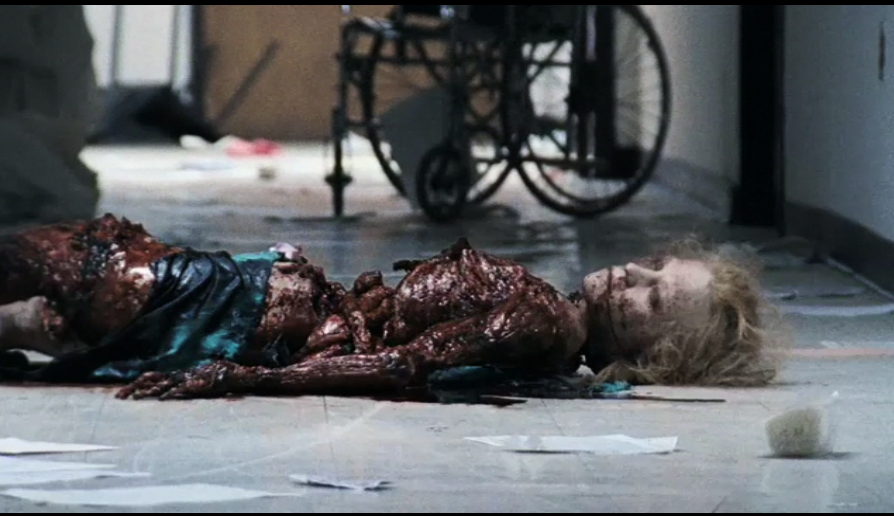

(Zombies apparently don't fear the FCC)
Right now one of the big discussions going on, is the fact that TV is doing movies job. Jim Emerson has been a big proponent of this, and like with most of what Emerson writes I disagree.
TV is a serialized medium, and Movie's are for the most part not. A long running film series, like say just for a point of example, Sam Raimi's Spiderman, is lucky to last 3 movies. Break it down, that movie tells "a story" over about seven hours, and five years. Compare that to the average Television show that last five years. That show if you break it down to forty minutes an episode, twenty two episodes a year is going to have seventy three hours to tell its story.
Now that is both a blessing and a curse, as even the greatest TV show is going to have some weak points (Anyone remember the "Cast Of The Sopranos argues with Indians about Columbus Day" episode?)
The grey area, it seems to me, comes on DVD. To take The Sopranos as the example again, there is no way you can tell me that David Chase didn't look at the extended multi episode dream sequence that opened Season 6 and say "Eh, It'll work on DVD." That's where I first saw it, and I think it worked pretty damn well, but people to this day still bitch about it because they saw it over the course of three weeks rather then three hours. My point is, there may not be a huge amount of difference in how TV and Film is made. But there is a HUGE amount of difference in how they are processed.
That being said, if anyone is taking advantage of the new found porousness between the mediums it’s Frank Darabont. Able to transfer his Television crew from The Shield to shoot the down and dirty The Mist and able to effortlessly give The Walking Dead a sense of cinematic grandeur. Right down to the Drew Struzan poster.

(C'mon, that's fucking cool)
Darabont makes plenty of smart moves in the adaptation. He’s able to take concepts Kirkman didn’t think about until later (such as the consequences of Gun Fire) and introduces them as the rules of the world from Day 1. At first I have to admit I was a bit worried that the first arc of Walking Dead would be too slim to sustain a season of television. After all Kirkman tells the story in just one hundred and forty pages. But comic books are tricky, it’s not enough to tell a story in the thousands of pages a long running series can get, you have to be able to tell a story every twenty four pages as well. What Darabont does is expand the story without really adding any extraneous filler material. Where Kirkman had to be ruthlessly concise Darabont can stretch out a little. Taking scenes like Rick’s escape from the hospital, characters like the man who saves Rick, and relationships like Rick’s with Shane, all almost throwaways in the book, and expands and deepens them. It’s like being able to glance at what happens just before and after the various panels. The Walking Dead stands as an example of adaptation that is damn near perfect.
I may not agree that Television is supplanting movies. But I will gladly agree that The Walking Dead is scary, better made, and more human then any of the pathetic offering we horror fans got this October.
If the show remains this good, and its source material has laid down an excellent road map to it doing just that (provided that they keep the prison to just one season) I think we’re looking at a serious classic of the genre.










 Posts
Posts


