Showing posts with label 1960s. Show all posts

Saturday, November 6, 2010

The Unseen #49: The Trip


Why’d I Buy It?: Came in the Roger Corman Boxset I Purchased (Last One Of These!)

Why Haven’t I Watched It?: Indifference.

How Was It?: There is a problem inherent in making any movie about psychedelic. As anyone who has ever dabbled in it even the slightest bit knows, any hallucinations in the Beatles sense of the word is completely secondary to the profound shift in perception that occurs in the user.

(Not entirely accurate)

In other words what’s remarkable isn’t so much that you would meet a clown with the face of a fish who speaks in the voice of your dead auntie. Its that this would not surprise you at all. But it's not even really about that either, its about the sense of connectedness, seeing behind the makings of things however temporarily. A sense of profundity. However fleeting it ultimately silly it may feel in the harsh light of sobriety.

So basically no matter how many fish eyed lens, vibrant colors, quick zoom ins and zoom outs, or how much you shoot in Widescreen without anamorphically adjusting the image you’re never going to capture that intangible feeling. Which is why so many of the most famous psychedelic movies, Fantasia, 2001, The Fountain, have absolutely nothing to do with Psychedelia.

Instead, you’re going to just waste your time and effort looking really really silly.

Which is as you may have guessed exactly what happens in The Trip.

The kind of movie were people do things like were Nehru Jackets and speak lines like “Hey don’t bogart that joint!” whilst wearing them, all without even the slightest whiff of irony..

Peter Fonda plays a young executive suffering from malaise (were there any other kind in the sixties). He procures some acid from Dennis Hopper (always a dicey proposition at best) and with Bruce Dern as his spiritual guide (once again, always a dicey proposition at best) he wanders out into the night on the Sunset Strip. A Place where young nude painted dancers gyrate wildly to music provided by a band called Electric Flag. Brightly colored strobe lights flicker and everything is always canting CANTING CANTING!!! He also wanders in and out of random peoples homes. Giving long winded musings about commercialism, sex and women’s lib. Some are so pleased to find Peter Fonda stoned out of his ever loving gobstobber has deigned to stumble into their home and drop his science that they have no choice but to have sex with him. I have a feeling he would have less success if he tried this now.

Also Bruce Dern pulls him naked from a pool.

It all culminates in the hallucinogenic “Trip” of the title. In which Dennis Hopper wearing purple velvet menaces Fonda as he rides a carousel (Man I’ve been there) and then Fonda looks at pictures of Che Guevera, Sophia Loren, and Khalil Gibran (one of those things is not like the other) with mounting horror until he screams “BAY OF PIGS!!!”

It’s all profoundly inexplicable.

As you might have surmised The Trip is a pretty big turkey. But I think its almost impossible not to have fun with. It’s goofy as you can get, and calling it a time capsule does damage to the right honorable and venerable tradition of Time Capsules.

But every once in awhile it is nice to remember that for however briefly there was a time when Nehru Jackets and a band called Electric Flag were both the very height of cool.

Friday, October 22, 2010

31 Days Of Horror: Day 22: The Unseen #42: The Premature Burial


Why’d I Buy It?: Came with the Roger Corman Boxset I purchased.

Why Haven’t I Watched It?: It’s a Corman Poe picture that doesn’t star Vincent Price. Which is like Bruce Springsteen without the E Street Band. Yes The Ghost Of Tom Joad is a very nice album, but no one’s is ever going to confuse it with Darkness On The Edge Of Town or Tunnel Of Love.

How Was It?: Well, better then I expected in segments, and worse in others.

The story as you might have surmised from the title, follows Ray Milland playing a man with a morbid fear of being buried alive. The film is called The Premature Burial, no points for guessing what happens.

I don’t think anyone would argue terribly strenuously, if I said that this is the least of Corman’s Poe Films. It lacks both the frenzied lurid intensity, hallucinogenic color saturated style and strange unearthly beauty of The House Of Usher, Tomb Of Ligeia, and The Masque Of The Red Death. Only Milland’s perfunctory “Drawings O’ Satan” really even wave in this direction.

Furthermore, Milland, though a fine actor in his own right just doesn’t quite hit that same wavelength of melodrama without camp that Price maintained throughout The Poe films.

Worse, the film is narratively disjointed, even for a Corman film. Though all of the Poe Picutures had to leap through all sorts of odd narrative hoops in order to drag their twenty to thirty page source materials into feature length. The Premature Burial takes this to the extreme.

It’s understandable, unlike the other Poe storys which at least give small opportunity to expansion, there’s really not much to deal with in original The Premature Burial. A fellow is buried, it’s a touch premature, he deals with the consequences of this. Oh hey it turns out he was actually on a ship, and just randomly lost his shit. Have fun turning that into 90 minutes, with a poster to bring in the drive in crowd.

So yeah, there’s a whole bunch of filler. Milland builds an elaborate premature burial proof tomb, just so he can destroy it in the subsequent scene. Dark family secrets are disclosed just so they can be forgotten. Long elaborate hallucinogenic nightmare scenes take place just so the film can get that much closer to feature length. Etc. Etc.

This unpredictable plotting ends up being the film’s secret weapon when (minor spoilers) the film, apropos to nothing suddenly morphs into “Raymond Milland’s Badass Revenge” (AKA Ray Milland Brings The Pain) in its last fifteen minutes. Dishing out some a Bride level of hurting bombs to all how have injured and annoyed him over the course of the runtime.

That’s fucking badass.

The Premature Burial belongs to that odd class of movies, that I can’t recommend but would never dissuade anyone from seeing. While there’s a lot that doesn’t work, there’s a lot that does, including the burial itself and the afore mentioned final fifteen minutes. It probably works best when viewed as a variation on Corman’s Poe films, which in all fairness is exactly what it is and will probably play best with foreknowledge of said same.

It doesn’t work in the usual ways, but it works in some very unusual ones.

Monday, October 4, 2010

31 Days Of Horror: Day 4: Onibaba

This is part of the Final Girl's Film Club from the immortal (we hope) Stacie Ponder.


The first thing you will notice about Onibaba, is that Onibaba is hella classy.

Seriously, it’s like class up the wazoo. Classier then Axe Body Spray, Red Bull, and Ron Burgundy’s well wishes combined.

I’ll stop now, I promise. Maybe. The point is that Onibaba is one arty ass film which derives it’s terror from psychological torment and hypnotic elliptical beauty in both cinematography and design. This is directly opposed to most other films that will be featured on 31 Days Of Horrror, which derive their terror from a giant mountain man ramming some sort of bladed tool through an unsuspecting citizen.

The movie follows a old woman and her daughter in law. Her son to go fight in a war, and she and her daughter in law must fend for themselves. Which they do by trapping and killing stray samurai in a nearby very large metaphor.

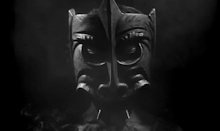
This merry little arrangement is soured when the missing son’s friend show’s up, announces the kid is dead and then shacks up with his wife. The mother afraid that they leave her she might sink even lower, begs them to stay, and when that looks like it might not work, she starts preying on her daughter’s superstition with the help of a Demon Mask that she took from a young samurai she killed.

As you might suspect, things are about to get all kinds of allegorical up in this bitch. Oh and face melting too. Face Melting is definitely about to get up in this bitch ass well.. Allegorical face melting. With the class. Seriously, this makes The Innocents look like Black Sheep or Saw III in terms of reserved grandeur.

Every frame looks like it should be hanging on Morticia’s and Gomez’s wall. This is like The Barry Lyndon of Horror films. The great thing about Onibaba is that the self evident artistry in it’s making never once overwhelm the pulpy brilliance of its premise. It’s like if Kenji Mizoguchi directed an episode of Tales From The Crypt. (Wait isn't that Ugetsu?... I'm going to cinephile hell aren't I?")

Of course as by the rules of this particular brand of moralistic genre fare, those who live very large metaphor must eventually die by the very large metaphor. But the way it gets to that point are not all easy to predict. It’s a film that’s aiming not to scare, but to terrify. And that kind of film is much rarer, its something the seasoned film fan isn’t always ready for, and it puts even the most jaded watcher somewhat off kilter. It’s not just the animal reaction most horror film’s go for, Onibaba want’s to get a level of intellectual revulsion as well as physical revulsion. And it succeeds.

At the end of the day, Onibaba may not be a film I’m always in a big hurry to rewatch, but it is the perfect thing for the discerning genre fan who wants something a little different.

Saturday, September 25, 2010

Somebody Asked Me To Be An Expert In Something Part 7; One Two Three

Tensions between the Soviet Union and America were coming to an all time high, while Wilder was making One Two Three. The filming of the movie was actually interrupted by the building of the Berlin Wall. So of course Wilder took the opportunity to do what he always did, and make the whole thing look as ridiculous as possible.

Wilder was coy about One Two Three’s ambition, in Cameron Crowe’s Mammoth interview with him he expresses no more ambition then “To make the fastest film in the world.”

It wasn’t that it was unheard of to poke fun at the tense relationships between America and USSR. Wilder had even done it before himself, cowriting Ernest Lubitsch’s Ninotchka, with the famous tagline “Garbo Laughs” was probably the most famous version of this and a few years later Stanley Kubrick’s Dr. Strangelove would be the ultimate version of it.

What was unusual, and something even Kubrick didn’t tread upon, is the fearless way that Wilder posits that the entire Cold War is one big put on. That the ideologies on both sides are a put on. False platitudes, mouthed by unthinking simpletons after they’ve been drilled into their heads by wiley conmen. Only a real smooth operator like Cagney can survive with any kind of sanity intact.

This was James Cagney’s last film, aside from a brief appearance in the film Ragtime twenty years later. And he picked a real winner to go out on. It’s not just that his last one was a great movie, it’s that his last film was a movie that was tailor made to showcase what a unique actor he was, the entire film is based upon his staccato rhythms and swagger.

It was on the set on this film that Cagney delivered his famous maxim on acting, “Walk into the room, plant your feet, look the other guy in the eye and tell the truth.” A statement that makes me sorry that he and Wilder didn’t make more then the one film together.

Wilder was nothing if not a truthful director. That truthfulness is often mistaken for misanthropy. But Wilder always much too amused by people far too much for that. Wilder’s targets in One Two Three, are almost excluisively ideological and institutional. Both the vapid “late stage capitalism” of the heiress, and the fire and brimstone idiocy of Piffle are seen as the province of easily duped stooges. Daringly Wilder goes so far as to suggest that Nazism and the old aristocracy it replaced was the exact same thing. There’s not a character in the film unwilling to sell out what they believe in, when the opportunity presents itself. Only the amoral Cagney, who subscribes to no higher allegiance then the Coca Cola Company makes it through the film with any kind of dignity intact.

This all makes the film sound very dour and serious, which it’s not. Instead it’s one of the quickest farces ever made. If Wilder did not succeed in making The fastest film ever made, he came very close. But that doesn’t mean it doesn’t have some very sharp teeth. The film’s most famous shot reveals has a “dancing” potrait of Khrusecv fall to reveal a dancing portrait of Stalin.

It’s a shot that to me, sums up the Wilder technique, revealing the truth with a laugh.

Sunday, September 12, 2010

The Unseen #38: Home From The Hill


Why’d I Buy It?: Came with the Robert Mitchum Boxset I purchased.

Why Haven’t I Watched It?: No real reason beyond the film’s non reputation.

How Was It?: A huge mess of unseemly fun. And after consecutive reviews of The Last Exorcism, Winter's Bone, and this, I have no choice but to conclude I've got the south on the brain.

Home From The Hill, begins with Robert Mitchum getting shot by an irate husband, whose wife Mitchum has been sleeping with. Like all the ladies say, “Once you’ve had Mitchum, you go on ahead and pitch ‘em” (short notice, you do a better one). So the husband did have some right to be angry. Mitchum shakes it off though, he’s a Texas land baron who runs his empire like a fiefdom and that girl is just one of many. Besides as Werner Herzog might say “It was not a significant bullet.”

But age is starting to catch up with Mitchum, so he decides to start training his boy to take over in his stead. A training that involves plenty of wild boar fighting. Over the course of a couple of years every skeleton the family has in its closet gets dragged out kicking and screaming, in the prime fifties melodrama fashion and a few new ones are stuffed in their to replace them to boot. This all makes for some good watching.

Home From The Hill, was directed by Vincent Minelli, best known today for being the gay man who loved Judy Garland so much he married her, somehow making him more, not less gay. Home From The Hill is the kind of overheated melodrama that Minelli made his specialty, second only to Douglas Sirk in that particular Sub Genre.

The thing to remember about this particular kind of film is that they were as A list as you could get, the equivalent of today’s Oscar bait. Which is important to remember, because these films often feel like they’re literally insane. There’s a dog versus Giant Wild Boar fight that looks suspiciously like the real thing. There’s a kind of vitality and unpredictability to this kind of filmmaking that is completely lacking in today’s. Remember this is a prestige A list picture…. And it has a wild boar fight in it. As versatile as George Clooney is I don’t expect him to battle a wild boar in his Oscar bait.

The cast is filled out with the likes of George Peppard, George Hamilton, Eleanor Parker, and Luana Patton, not a group of what you would normally call heavy hitters, but all doing career best work.

Home From The Hill might seem a bit odd to the modern viewer. It’s spread out over two and a half hours and takes it time not getting anywhere in particular. It might all amount to Giant for the slow, stripped of its ambition and iconography (though not artistry this is Minelli we’re talking about here). But any movie that features Robert Mitchum surrounded by hunting hounds, drinking corn whiskey from a bottle, talking about manliness, while sitting on a throne like a cracker Lear, is more then alright in my book.

(Remember kids, Pimp is spelled M-I-T-C-H-U-M)

Saturday, July 10, 2010

Somebody's Asked Me To Be An Expert In Something: Part 4

You may remember a while back that thanks to my print critic work I was asked to head up a local Film Noir festival. Well we're doing a sequel of sorts this July with a batch of Neo Noir films. Today I'll be talking about Point Blank and thought I'd share what I had to say. Sorry if the syntax is funny its written for speech.


Point Blank is a tough film for me to talk about, as I think it’s a pretty great movie and a pretty terrible adaptation.

Point Blank is based on the first Parker novel, The Hunter by Donald Westlake. Though Westlake wrote many books and screenplays, including those for The Grifters and The Stepfather, he’s still best known and well beloved for the two long running series he wrote. The first The Dortmunder books are a series of comic capers, involving the titular luckless thief and his bedraggled crew. The second which he wrote under the name Richard Stark, involves the ruthless thief Parker.

Despite their tight plots, and well drawn characters the studios have had nothing but trouble bringing these characters to the screen. With the Dortmunder books it’s the usual case of bad studio decisions, including the casting of a young Robert Redford as the perpetually hangdog Dortmunder. With the Parker novels the reasoning is a little less straight forward. Its been tried many times, with many different actors playing Parker, including Lee Marvin, Robert Duval, Jim Brown, Mel Gibson, Peter Coyote, and even Anna Karina. Though in one of those touches that makes you shake your head, not one of them has ever been named Parker.

And yet despite the honest efforts of so many, Marvin is great tonight, Duval is probably my favorite, there’s never been a film that accurately captures the tone of Westlakes Novels. For the reason why, lets look at what Dennis Lehane, who as far as I’m concerned is the greatest living writer of crime fiction, and if you like this stuff you owe it to yourself to check out a few of his books today, wrote in the introduction to the new addition of the Parker books that were just released, after a long spell of being out of print.

“Parker. The greatest antihero in American noir. If Parker ever had a heart, he left it behind in a drawer one morning and never came back for it. He never cracks a joke, inquires about someon’s health or family, feels regret or shame or even rage. And not once does he wink at the reader. You know the Wink. It’s when the supposedly amoral character does to let the reader know he’s not really as bad as he seems. Maybe in fact, he’s been a good guy all along.

Parker IS as bad as he seems. If a baby carriage rolled in front of him during a heist he’d kick it out of his way. If an innocent woman were caught helplessly in gangster crossfire, Parker would slip past her, happy she was drawing bullets away from him. If you hit him, he’d hit you back twice as hard. If you stole from him, he’d burn your house to ground to get his money back. And if, as in Butcher’s Moon, you were stupid enough to kidnap one of his guys and hold him hostage in a safe house, he would kill every single one of you. He’d shoot you through a door, shoot you in the face, shoot you in the back, and step over your body before it stopped twitching.

Nothing personal by the way he gets no pleasure from the shooting or the twitching. He’s a sociopath, not a psychopath. But what he is above all is a professional.”


Understandably, adapting something that harsh can make studio execs a little queasy. Which is why, though many Parker books have been adapted, The Hunter, the one tonight's film is based on, keeps getting remade. It might not be pretty, but at least Parker is doing these dirty deeds based off of a recognizable human emotion like the desire for revenge. And not just a profit motive.

So if I believe this film, is at best a misinterpretation of a series of books I and many others hold in very high regard, why do I like it so much?

Well for one thing it just plain neat!

Director John Boorman has had one of the strangest careers in modern film, switching between excellently made but somewhat standard movies like, Deliverance, Hell In The Pacific, and The Tailor Of Panama. And films that are, completely insane. Its like he feigns normalcy long enough to get the studio executives to look the other way, and the next thing you know he’s making Zardoz and there is Sean Connery in a thong, and a giant stone head screaming that “The Gun is good, The Penis is evil.” Or it’s the Exorcist 2 and he has James Earl Jones dancing around whilst dressed as a giant Bee.

Here he comes the closest to making an American French New Wave film. The most famous thing about Point Blank is its non Linear editing, the way the scenes seem to dance around their central point. You’ll see flashes of the past intrude on the present, and previews from the future. It’s a jarring style, and in the hands of a less competent filmmaker it could be annoying but Boorman pulls it off.

The film is also a great LA noir, with the swinging sixties vibe going around in the background. The first round of Neo Noir, starting from the end of the first cycle, to Chinatown, was often set in LA. Then as now still a city in flux. In many ways that city which is so many cities is the ideal place for a noir. Raymond Chandler certainly thought so. And if you’re interested to see more films that play with this genre, location and era, I highly recommend picking up Paul Newman’s Harper, The Long Goodbye, and The Late Show.

The film also hinges on Marvin’s performance. And seldom if ever, has his “huge slab of walking granite” persona been used to better effect. Marvin was never just tough, he’s beyond tough, picking a fight with him, would be like picking a fight with Mount Rushmore.

And yet there’s a certain sadness to his performance here that I don’t think you ever really saw again from Marvin. Revenge becomes his only reason for existing. And when he gets it, there’s nothing left for him.

There are those who even read the film as a ghost story. If you watch closely you’ll notice that Marvin never actually kills anybody in the film, And once his unfinished business is done he fades back into the night. Many a film noir are narrated by a corpse, this might be the only one that stars one.

Saturday, June 12, 2010

The Unseen #29: The Young Racers

Time For Another Installment In Things That Don’t Suck’s Red Headed Step Child. THE UNSEEN!!!


(For once you will get EXACTLY what the poster promises)

Why’d I Buy It? : Included in the Roger Corman Box set I bought.

Why Haven’t I Watched It ?: To quoth Murderface The Young Racers lacks a certain zazz. There’s nothing WRONG with The Young Racers but when its placed next to the lurid delights of something like Bloody Mama, X The Man With X Ray Eyes, or A Bucket Of Blood, The Young Racers can’t help but look a little anemic.

How Was It? : Interesting. The Young Racer’s isn’t a movie I would call good. But based on the way it acts as both a perfect example of and exception to Corman’s work, makes it a must see for any fan of his.

The film follows a kind of douchey professional racer touring the European circuit. He’s basically kind of an asshole and seems to be suffering from both raging narcissism and a half formed death wish. He’s befriended by a young journalist/novelist/would be race, who joins up with the racer’s entourage made up of his resentful brother, bored wife, willing groupies, and assorted hangers on. But does the young journalist have a, DUH DUH DAAAAA, ulterior motive.

On one level it’s a total fulfillment of the Corman Formula. Find a gimmick (racing). Find an exotic location (Europe). Go on from there.

On the other hand, The Young Racers feels atypical of Corman. For one thing, it doesn’t look cheap. The racing sequences have a real feeling of scope and speed, most of them are set not in tracks but on city streets, which presumably had to be blocked off, so as not to kill the pedestrians. For another, Corman pads the film with footage of his disaffected young cast walking around Mediterranean villa’s saying vaguely angsty things to one another. The result looking uncannily like a Roger Corman produced Antonionni film.

The real problem with the film is that its cast is deeply unappealing. With neither the star in his fading twilight years, nor brash up and comer that Corman was usually able to provide to anchor the picture, we’re left watching a bunch of bland people participating in skullduggery between the heats.

Who do we root for? The vain preening ass hat veteran? Or the callow non entity journalist? Or should we ally our sympathies with the vapid Euro hotties who Corman owed a favor to. Like Hitler versus Stalin whoever wins humanity ultimately loses.

Still despite the utter lack of any rooting interest Young Racers remains an appealing watch. The racings scenes are in themselves worthwhile. And in the era of the queasy cam its almost obscenely gratifying to watch a film made by someone who knows the value of relative motion. Plus its kind of fascinating to watch a filmmaker as thoroughly attuned to Midwestern sensibilities as Corman deliver his version of swinging sixties Euro Sophistication. Its like watching a Hee Haw episode centered around La Dolce Vita. Where Stock Cars, decadence and ennui meet on equal footing. On second thought this movie is kind of glorious.

Thursday, June 3, 2010

Easy Rider


One of the lines thrown around in the Hopper obits was the statement that Easy Rider could never be made today. Like so much conventional wisdom its right for the wrong reasons. Its true that today Easy Rider could never be made but not because of its libertine attitude towards sex and drugs, loose non plot driven structure and fearless attitude. Easy Rider could never be made today because any movie as earnest as it would be laughed out of the theater.

Easy Rider is about as deeply unironic as movies get. Shocking coming from the pen of perennial smart ass Terry Southren. It’s a film filled with pompous dialogue, a smug central performance by Fonda, cheap obvious symbolism, and dated editing trips. And if the film lacked a single one of these elements it would not be near so great. It’s a student film in the best sense, that its earnest enough to think it matters. There are worse faults to have.

But there’s no getting around the fact that so much of Easy Rider is so unabashedly goofy from literally beginning to end. From the shot of Peter Fonda throwing away the watch, to the soulful hippies endless prayer in the commune, and the film’s New Orlean’s climax which once seemed revolutionary and now seems like a kind of event horizen for datedness. Most spectacularly is the scene when well hell I’ll just let Ebert tell it…

One of their bikes needs work, and they borrow tools at a ranch, leading to a labored visual juxtaposition of wheel-changing and horse-shoeing. Then they have dinner with the weathered rancher and his Mexican-American brood, and Fonda delivers the first of many quasi-profound lines he will dole out during the movie: "It's not every man who can live off the land, you know. You can be proud." (The rancher, who might understandably have replied, "Who the hell asked you?" nods gratefully.

A hitchhiker leads them to a hippie commune that may have seemed inspiring in 1969, but today looks banal. A "performance troupe" sings "Does Your Hair Hang Low?" on a makeshift stage, while stoned would-be hippie farmers wander across the parched earth, scattering seed. "Uh, get any rain here?" Billy asks. "Thank you for a place to make a stand," Captain America says. The group leader gives the Captain and Billy a tab of acid and the solemn advice, "When you get to the right place, with the right people -- quarter this."


And yet incredibly. Hell damn near inexplicably Easy Rider ISN’T just a dated period piece and does keep some of its elemental power. The scene where an impossibly young Jack Nicolson solemly tells Nicholson and Hopper about the aliens, is still a blast. The shots that Hopper gets of the American landscape are as a beautiful and haunting distillation of the country as anything I’ve ever seen on film. The montage of the pairs final drive cut to “Its Alright (I’m Only Bleeding)” still conjures up a terrible dread. Hopper, Nicholson, and yes even occasionally Fonda are all charismatic as can be. And the editing and techniques are dated as hell but there audacity still impresses.

Its true that I can’t make it through a good dozen of Easy Rider’s sequences without laughing. But looking at the way the film so unabashedly mattered, both to those who made it and those who saw it; I can’t help but think the joke is on us.

(Expect a Hopper heavy week here on TTDS. I’m not doing anything formal and I certainly have other stuff I’m going to write about. But I write what I watch. And I’m watching a whooooollllleeee lot of Hopper.)

Monday, May 24, 2010

The 25: Part 10: Dr. Strangelove

(The twenty five is an examination of the twenty five films that made me a cinephile. These aren’t necessarily what I consider best movies, nor are they necessarily my favorite. Though in some cases they are both. Instead these are the films that made the biggest most indenialable impression on me. Films that if they hadn’t hit a certain way at a certain time I would not be the same film goer that I am today. They’re the twenty five.)


Kubrick is a director important to the development of any film goer.

More then his supposed coldness and clinical nature I think the thing that bothers people about Kubrick’s films is the fact that he makes art that seems to look back. You judge a Stanley Kubrick movie, but it judges you as well, and each time you square off you’re different, and the film reflects that. I don’t think that it’s a coincidence that Kubrick is one of the first filmmakers that hardcore cinephiles often come to on their journey. And its not just the fact that he’s well known in the mainstream as a true artist either. That rarest of things a famous intellectual.

His career seems almost purposefully the career of a gatekeeper. Fourteen films. No more no less. You can watch them in a weekend if you want to. Likewise, you would be hard pressed to find a more adult filmmaker then Kubrick, but there are really only four films that contain (explicit) content that could be called objectionable to a child (Clockwork, Full Metal Jacket, The Shining, and Eyes Wide Shut). And even with as parents as over protective as mine I had seen all those by the age of sixteen.

But Kubrick is there at the start of the dojo to test you. Can you engage a film? Can you be engaged by a film? Do you want to? Is a challenge what you want from your art? Or are you merely a passive observer?

By the end of your time with Kubrick you know.

As a result every Kubrick fan has the films that don’t work for them, for me it’d be the shrill dated Lolita, and the flat depressingly shallow (though stylistically fascinating) The Shining. As well as the films that do; The dreamlike achingly human Eyes Wide Shut, the brutally funny Full Metal Jacket, and 2001 A Space Odyessy, a film often cited as one of the greatest ever made that still underrates it. I’m sure that there are readers aghast at the way I dismissed Lolita and The Shining, the same way I feel when others dismiss Eyes and Full Metal. The point I’m trying to make is that unlike other filmmakers I don’t think there IS a wrong answer to what your favorite Kubrick movie is. They act, at least partially, not as art but psychologically. Moving Rorsarch blots that coax something out in the personality of whomever watches them and forces a reaction.

Still for all his work, and all his rewards there is something about Strangelove, that makes it remain the fundamental Kubrick for me.


In Strangelove, demands the biggest reaction of all. With the gall to present the extinction of our species as the over due punchline to weary joke. Presenting the Cold War as a nightmare mixture of saber rattling, sexual repression, and children playing with matches.

Dr. Strangelove is at its core, about what happens to madness when it becomes institutionalized. When the deaths of tens of millions of people, and indeed the planet, are not the found in the ravings of a demented Colin Clive, but discussed calmly and rationally by a series of army and government bureaucrats. Of course its funny anything this absurd has to be.

For all the talk about how hermetically sealed Kubrick’s films were, Strangelove is downright lively. Deftly juggling its large cast, three main courses of action, and always finding the time for that perfect line, or surface detail to frame it (“Of course I like saying hello Dimitri.”)


Of course much of this spontaneity has be credited to Strangelove’s deft comic cast. Particulary Sterling Hayden in his somewhere beyond deadpan performance as Jack D. Ripper, a man who has decided to start a nuclear holocaust in retaliation for what he believes is a communist plot to make him impotent (“I first became aware of it Mandrake during the physical act of love…”). Matched in Madness by George C. Scott, in what is perhaps his finest hour, as an uber hawk that makes Patton look like a dove and who just can’t wait to get things started. Then there is of course a never better Sellers, whose genius in all three parts, the civilized thoroughly mortified Colonel Mandrake, the in over his head president, and the demented titular doctor. Who ends up inadvertently turning an ecstatic, “Mein Fuehrer I Can WALK” Into the planets epithet.

Slim Pickens also deserves special mention. He tends to get slighted for his performance in this movie, thanks mostly to the never really substantiated rumor that Kubrick never told him he was in a comedy. I always thought this did a great disservice to Pickens (not to mention the ugly undercurrent of “hehe dumb hayseed” the anecdote contains) who proved himself time and time again a good actor and sly comic performer (“HORSES?!?! HORSES are expensive!”). He was more then capable of playing with the big boys, and I find it hard to hear his “Shoot a fella could have a good weekend in Vegas with that stuff.” Not to mention his final orgiastic ride, without believing he was in on the joke.


The film is filled with vast Kubrickian spaces. The war room with its model earth, ominous halo of light, and pinpoint eyes of the venal men taking us to our doom. The military base which uses a giant “Peace Is Our Profession” billboard. As the backdrop for some brutal American on American combat (maybe the only time in Kubrick’s career that he can be accused of being “On the nose.”) Like all of Kubrick’s great spaces they are familiar as they are alien. As mundane and meaningless as OPE POE.

Kubrick is so often derided as a perfectionist, that it is often forgotten how often he achieved perfection. His a oeuvre that does not merely reward repeat viewings, but demands them.

Thursday, May 6, 2010

The 25: Part 8: For A Few Dollars More

(The twenty five is an examination of the twenty five films that made me a cinephile. These aren’t necessarily what I consider best movies, nor are they necessarily my favorite. Though in some cases they are both. Instead these are the films that made the biggest most indenialable impression on me. Films that if they hadn’t hit a certain way at a certain time I would not be the same film goer that I am today. They’re the twenty five.)


I can’t think of another foreign filmmaker I knew before Sergio Leone. Despite the presence of Eastwood, Leone’s films remain so distinctly alien from their American counterparts, that they make the transition for the budding film fan easier. Familiar genre, sure, familiar stars yes, but the tone and style is so different, that they might as well be transmissions from Mars.

My Father loved the old Westerns, the works of Hawks, Ford, and Hathaway. It wasn’t until later in my film going life that I was able to appreciate those films for the poetic masterpieces that they were. Despite the fact that as a kid I had an unusually high tolerance for older film, at the time I was merely bored, and wondering why we weren’t watching a Sean Connery Bond instead.

The Leone movies though, those were different. Savage, stylistically, grimy, and funny. Wild in the way the other films weren’t.

I don’t know if there’s an opening shot to a movie I like better then For A Few Dollars More. Unconnected to the main narrative of the film, an unknown man rides on the plain, an unseen rifleman draws a bead on him, and blows him off his horse. Which run’s neighing across the plain before exploding into a stark Red and White animation as Ennio Morricone’s score comes in.

You now have my attention.

While it might not have anything to do with the film’s story it sells the tone plenty. Leone’s world is harsh and unforgiving and death is cheap and undignified. John Wayne never rode here.

For A Few Dollars More is often seen as the least of Leone’s Man With No Name Trilogy. But its my favorite of the three. Operatic where The Good The Bad And The Ugly is mythical. Expansive where Fistful Of Dollars is Claustrophobic, For A Few Dollars More strikes the perfect balance in the series. While making room for a great performance as Lee Van Cleef, as the hard vengeance seeking hero Colonel Mortimer. Van Cleef controls every scene he’s in with an unfakeable hardness, and competence. Introduced stopping a train for his own convenience before hunting down a bounty with his wonderfully preposterous, borderline fetishtic rifles, in a fantastic scene.


All around this has to be one of the best cast Westerns ever made. Even Klaus Kinski shows up for the fun, in a performance that impressed me before I knew I should be impressed. It’s a small role but he steals every shot he’s in as a walking twitch of a man with a hunch back, who seems .2 seconds from going off at any given moment. The moment where Van Cleef casually strikes a match off his face, daring him to break rank and do something about it, is one of the tensest in the film.


Indio, played by Gian Volonte, returned from Fistful and playing a much more effective bad guy then the dandyish Ramon in same, is still one of my favorite villains. Savage and brutal, but elegant and thoughtful as well. A self reflective monster with just the right touch of sadness to him to make him scary.


But really it all comes down to Clint. Far from the clean cut heroes of the American Western’s The Man With No Name is a harsh, sneering, badass with a fully developed anti authoritarian streak. Watching him bust down a corrupt sheriff after doing his job for him, is a rare joy. He inhabits every scene with a swagger, dominates every conversation and gun fight with confidence and ease, and yet seems strangely vulnerable before Leone’s lens. For all his iconic glory there always seems that possibility that The Man With No Name will meet his match. He never knows all the angles he just thinks he does.

Its not just the actors in top form. Morricone’s score, sparse and haunting is one of his greatest. Particularly the central pocket watch theme which ends up at the core of most of the films major sequences.

Leone’s in top form as well. The film contains many of his best sequences. The eerie early morning prison raid set to Morricone’s tolling bell. Indio delivering his parable from the pulpet of the abandoned church, gives a normal “master plan” sequence a delightful satirical edge. The final showdown with Indio’s gang, both the town clearing shoot out which is some of the greatest action Leone ever shot, and the final showdown between Mortimer and Indio which is right up their with the climax of The Good The Bad And The Ugly for sheer tension. Clint in the aftermath piling his bounty of bodies on his mule cart adding up his winnings with ghastly good humor.

Its no secret that Leone’s greatness comes from his oft parodied ability to stretch a sequence far beyond its natural limits. But its not just his famous shoot outs that employ the technique. Take for example the scene in which Indio’s troops scope out the bank, counting how long it takes for the guard’s to make their circuit. A normal director would have left it at that, having delivered the exposition that the gang have cased the bank. Leone stretches out the scene as long as it can go. Cutting to each gang member (and our heroes) as they count off the guards steps. In the process he makes the scene unforgettable.

Despite the number of films I’ve seen since For A Few Dollars More, its wonderful odd foreignness still exists. It has a structure and a tone nearly unrecognizable to when compared to the Robert McKee school of act driven screenplay. Take the comic interlude involving a lusty properties of a hotel and her nebbish dwarf of a husband, which Leone lets play out beyond all reason. The effects charming, like watching a small comic interlude between the plays at a Vaudeville house.

Despite the effect on me, I can’t pretend that For A Few Dollars More made me run out into the street demanding fast helpings of world cinema. But it was a start. Others would come and build on that start, which we will come in their own time.

At the time For A Few Dollars More is what it remains for me today. A Ferociously entertaining film directed by a master and starring one.