Showing posts with label A-Z. Show all posts

Wednesday, March 9, 2011

Project A-Z: Scenes #8: Fear And Loathing In Las Vegas: The Crest Of A High And Beautiful Wave

The moment I picked Fear And Loathing In Las Vegas as part of Project A-Z I knew I had to do it as a "Scenes." There's no choice really, Fear And Loathing In Las Vegas is really nothing but a bunch of high powered vignettes thrown together. I could have pressed the fast forward button, closed my eyes, stopped it at random and would have in all probability a great scene to dissect.

This is exactly the thing that makes the film so maddening to its detractors. It just does not stop. Relentless doesn't cover it. Ebert famously quipped that "If you encountered these characters like this on an elevator, you'd push the button and get off at the next floor. Here the elevator is trapped between floors for 128 minutes." and in his recent review for The AV Club Scott Tobias seemed somewhat undone by the film (He also suggests that Enter The Void's relentless slog of human ugliness is somehow more appealing then Gilliam's KER-azy psychedelia. Suggesting he comes from Rand McNally. As an aside Mr. Tobias is actually responsible for the name of this blog. Though that is another story...)

But the thing that the detractor's miss is that just because it is unpleasant doesn't make it inaccurate. In the case of Fear And Loathing what is on the screen is what is on the page. You don't go see an adaptation of Moby Dick and then bitch that the whale is white.

And it's what on the page that made me finally decide to write up this particular scene in Fear And Loathing. But we'll get to that later...

We join the doctor as he lights up a bit of some unknown substance, at the end of a crazed chaotic binge. Now before you judge the doctor too harshly keep in mind that this...

Is what he was dealing with mere moments ago. I don't care who you are that'll make any man reach for the pipe.


Or er... Lightbulb... I've always thought that that is such a Gilliam touch. A little "Hey wait a minute." detail. The off kilter in the off kilter.

There are two things that are notoriously uncinematic, drugs and writing, and this scene fits in both.


And yet for all the tricks and stuff that have been used in the past nothing quite captures the powerful dislocative feeling of drugs as well as this simple shot. It's not just the couch moving. The foreground, background are all on different planes and as soon as Duke hit's whatever the hell that is they all become unattached from one another.


How Gilliam is that?


Contempt for worship of the sixties seems to have hit an all time high as boomer idealism continues to curdle at an exponential rate. Even I, who has a markedly higher tolerance for hippies then most of my generation could barely make it through a few of the solemner passages documenting the flower children, in Doctrow's Homer And Langley without laughing my ass off.


And yet, the feeling In Fear And Loathing seems earned. Maybe it's simply because Gilliam himself is a full fledged Hippie and this sequence set at "The Matrix" is as much his nostalgia trip as Thompson's.


Ah and there's the ghost of Christmas future himself. It's hard to look at Thompson now in the wake of his suicide. Hard for me to read him after he himself decided he had no answers. Thompson gave up, and though I know it isn't fair it's hard to not feel especially all these years later, that he didn't have the right. The carnival is running, still as crazy as ever and we need our barker. We need him and he is not here. It is just that simple and just that sad.


The fish eye lens and Terry Gilliam were made for each other.


The jump cuts that Gilliam uses to document Thompson's first encounter with LSD are a bit more standard then what he was using in the hotel room. This little vignette inside a vignette is just further proof of what a delightfully digressive (for me) movie Fear And Loathing In Las Vegas is.


... And that is one hell of a punchline.


Like I said, writing is almost as hard to film as drug use. And yet the words on the Voice over now are perhaps the most important in Thompson's career. Certainly the most important to himself. If there is any doubt just watch him rip Alex Cox a new asshole in Gonzo for having the temerity to suggest animating it.


These clips aren't presented in the usual congratulatory montage way the sixties are usually summed up in. But edited with the ferocity of the drug trips.


Slowing down only for a sly nod at both the beginnings of Thompson's career and the end of sixties.


The fact that we can look at that image without immediately laughing are a testament to Thompson's work.


In the closing moments with Thompson's words echoing through our ears it dawns on us. This isn't really about the sixties this is Thompson's version of the sixties. The reason it resonates isn't because of what happened it's because what it did to Thompson. He's telling his own version of the Garden Of Eden and it ends with him cast out and left alone with a head full of acid and a two hundred and fifty pound Samoan with a hunting knife. Worst of all he can still see the Eden, though it's forever out of his reach.


It's all there in that moment as much for Thompson as for us. That high cresting beautiful wave that crests and breaks just outside our grasp and then recedes, leaving us to chase it for the rest of our lives.

Tuesday, February 22, 2011

Project A-Z: Eyes Wide Shut

(One Day I cut an alphabetical swatch through my DVD collection for shits and giggles. Picking the first film that inspired me to write in alphabetical order. This is the result.)


Now that the dust has settled and Kubrick’s “ten year rule” has been proven once again can we all take a moment to acknowledge just how silly much of the initial critical reaction to Eyes Wide Shut was. All that howling over what a supposedly “unsexy” film Kubrick made, as if the critics were appalled and disappointed that the film wasn’t two hours and twenty minutes of Cruise and Kidman fucking. I know it’s tough to believe that a lot of critics at the time were disappointed that the last film by a great director wasn’t porn starring famous people, but go back, check the tape. They were.

Make no mistake Eyes Wide Shut may be an “unsexy” film but it’s profoundly erotic one. Not erotic in the sense of simple titillation, but in the deeper darker sense. Bill Hartford is a man who steps through the floor of his own mind and gets caught in the riptide that lies beneath it.

After being somewhat horrified by the thetan flopping in Vanilla Sky, a performance I’d previously found moving, it’s kind of amazing how well Cruise’s performance holds up in Eyes Wide Shut. How much of Cruise’s impenetrable surface Kubrick penetrates. It’s maybe the first time that Cruise has ever played someone small, someone completely overwhelmed by the things going on around him. Whether it be the demands of his patients, a marijuana buzz, his wives fetish for sailors, or a masked orgy. The twin slight repeating jokes, that everyone from the hotel concierge to the drunken Brooklyn kids making their way home from the bar, in the movie reacts sexually to Cruise and that Cruise is continuously, almost compulsively self identifying as a doctor take on an almost tragic light in this dimension. He keeps claiming himself as a doctor so he can claim that he is something. It’s as if he’s attending a party where everyone is having a good time but himself, and every time he makes a move to join in the consequences promise to be dire.

Kubrick famously considered shooting the story as a straight farce staring Steve Martin. The shocking thing about that isn’t that the idea is absurd but that it’s very plausible (You can still see it peeking through in the costume shop sequence which even goes so far as to feature wacky Japanese businessmen. The essential ingredient of dated 80’s comedy). The escalating episodic structure is exactly the same as a farce, and one can easily imagine Martin’s ever growing sense of frustration as he desperately tries to have sex with someone.

Of course that’s not the film we get and that’s the thing that makes Eyes Wide Shut such a rewarding and maddening film to revisit, it’s that the film that we did get is so elusive. Shifting tones like a prism. It’s an episodic film almost every scene could function independently, the scene between Cruise and the Hooker, plays like a first rate short story by Andre Dubus, The opening party scene with Sydney Pollack at it’s center a figure of desperate masculinity in shirtsleeves and of course the masked orgy centerpiece. Which features in the albino Birdman who leads the woman away one of the most striking death figures in modern art and in the infamous digitally imposed figures block out all the sex at the orgy scene is still one of the stupidest cases of censorship in recent memory. One whose gracelessness is only truly hammered home by the act of watching it (“But if they see sex in a movie about sex they might go mad!”)

The film isn’t perfect. One rather sizable flaw being the scene which sends Cruise out on his odyssey, aided by the most magically potent marijuana in the universe, is one of the most tone deaf in Kubrick’s career (Despite Kidman's best efforts). There is also no denying that the film feels a bit spent (if you’ll forgive the pun) after the climatic orgy. While it’s crucial to the film there’s no denying that Cruise’s half hearted attempts at penetrating the mystery are only so much aftermath further lacking urgency by the film’s very Kubrickian insistence that perhaps there is no mystery at all.

Still for all it’s flaws Eyes Wide Shut remains a masterpiece, and a fitting coda to the great filmmaker’s career (I for one find it his warmest film this side of Spartacus). It has the inconsistencies of a dream, but like the best of dreams it follows you out into the daylight and haunts your steps.

Thursday, February 17, 2011

Project A-Z: Dreams

(One Day I cut an alphabetical swatch through my DVD collection for shits and giggles. Picking the first film that inspired me to write in alphabetical order. This is the result.)
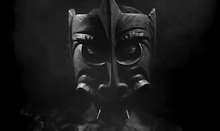


You see a lot of euphemisms thrown around reviews of Akira Kurosawa’s Dreams. Words like “stately” “deliberate” and “deeply personal.” All the phrases desperately trying to dance around what the writer really thinks. So let’s get this out of the way, Dreams isn’t just deliberate, it is occasionally as slow as molasses in January. Dreams is a film that requires patience There are no two ways about it. But it is also a film, which rewards patience. Both for the insights it gives into the artist who created and it and as a work of art in and of itself.

It is fascinating if only for the rare occasion of seeing a director usually so preoccupied making films about others finally turning the camera on himself. When Fellini made Roma no one was particularly surprised. But Kurosawa had always been such an unselfconscious filmmaker. Nevertheless the artist reflected in Dreams is surely the same as one who made Kurosawa’s films. All the preoccupations are there, his countries past and uncertain future. His awe at mankind’s boundless capacity for good and sorrow for the equally boundless capacity for evil. His praise for the individual. His love of community and fear of the mob. All are reflected in the eight vignettes he puts together.

“Your mileage will vary” may as well be the tagline for the film. Personally I have a great deal of affection for "Sunshine Through The Rain" and "The Peach Orchard", both of which view Japanese folklore through the matter of fact eyes of a child in a way that reminds me of nothing so much as the films of Guillermo Del Toro. "Crows", which features Martin Scorsese as a Van Gogh is another winner for me (I love the way he delivers the line, “The sun compels me to paint!”) Lovely choreographed to Chopin’s “Raindrops” it features a Kurosawa Stand in (wearing his trademark slouch hat) wandering through Van Gogh’s canvases courtesy of ILM (back when that last phrase inspired anticipation rather then fear).


"The Tunnel", "Mount Fuji In Red", and "The Weeping Demon" all contain some of the most potent imagery of Kurosawa’s career. With images from each that are literally unforgettable. The vast column of the dead marching from the gaping tunnel, the titular spectacle in "Red", and the long montage of the great mass of men writhing in agony, arguably the central motif of the latter period of Kurosawa’s career, that concludes "Demon". But all three are too uneven and at the end too stagy to work on their own as shorts.

Only "The Blizzard", really falls short for me. As I chastised others for mincing words in the opening paragraph perhaps I should clarify that by “falls short” I of course mean “Is nigh unwatchable.” An interminably paced vignette that doesn’t go anywhere or mean anything, "The Blizzard" is the one time where Dreams actually feels as pointless as a coworker trying to tell you all about the really odd dream he had last night. Trust me dear readers “The Blizzard” is what the skip scene button on DVD’s were invented for. It’s a handy place to take a smoke break if you happen to catch the film at a revival. But aside from that there’s not much to recommend it.

The film concludes with "Village Of The Watermills". Which is a microcosm for the film as a whole in a lot of ways. It’s slow and a bit preachy. But it’s also quite beautiful, and I can’t help but find it’s gentle affirmation of the human spirit to be very moving. The fact is I feel better after watching the closing moments of Dreams. There are those who accuse its ending of being a lecture. I say let it be, as a filmmaker who has given so much the very least I owe Kurosawa is a few minutes of polite attention to let him have his say.

Tuesday, January 11, 2011

Scenes #5: Clerks 2 (Project: A-Z)


(One Day I cut an alphabetical swatch through my DVD collection for shits and giggles. This is the result.)

Nothing has made me feel older then the decline in Kevin Smith's reputation. Not to get all "Back in my day" but back in my day liking Smith was a matter of course. Among a certain strata he was ubiquitous as Vans, Alex Garland's The Beach and Elliot Smith. Not only was he crude, funny, and talked about Star Wars, but he was the indie filmmaker who made it, one of us.

Now fifteen years in his career, on the backside of Zack And Miri Make A Porno, which earned Smith some of the best reviews of his career while tanking and Cop Out, which well do I even have to talk about the fall out from that one, Smith is looking like a very different filmmaker from the friendly, unassuming guy who made Clerks.

But still, even though I haven't like all of his movies, Jay And Silent Bob Strike Back doesn't really work for me, and it almost goes without saying neither do Mallrats, Jersey Girl and Cop Out, I've been kind of shocked by the glee that people take in being allowed to ignore Smith. True he's painted a big target on himself, but is that really a reason to ignore an entire body of work? This is let me say, despite my bet hedging a firmly positive piece on Smith, which is part of why I wanted to write it. I have a feeling they'll be in short supply.

After all...


There's no way a director who can communicate such levels of longing and apprehension with a simple fucking two shot, a slight push in and a fifteen year old pop song isn't worth some serious consideration.

But this is not the moment I want to explore from Clerks 2. A flawed but ultimately rewarding movie that has waiting inside it a perfect three minute gem of a scene, that is as perfect an expression of happiness as I've seen in a film and sums up everything likable about Kevin Smith as a filmmaker.

Clerks 2 takes as it's unlikely premise that Rosario Dawson is in love with Brian Halloran. Well look if I can believe in Jedis for two hours...

At the start of this scene, Halloran has confessed his apprehension about dancing at his wedding, so Dawson's taken him up to the roof to show him a few moves...


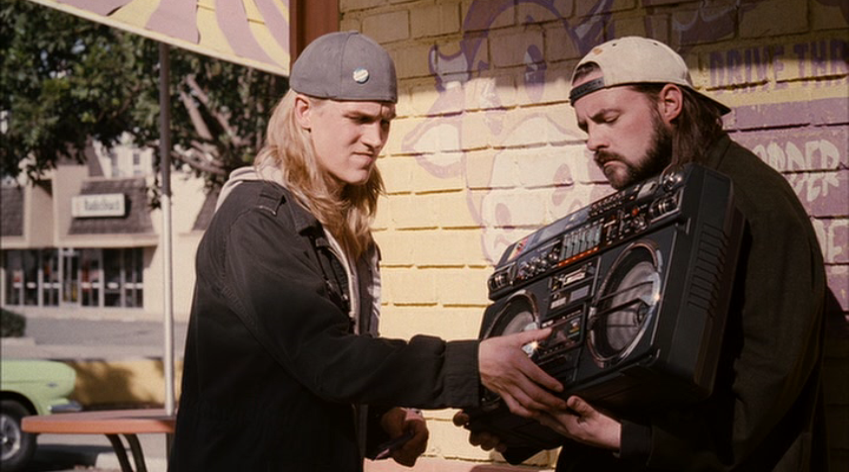
Enlisting the help of Jay and Silent Bob and their Jambox. Because of course it's a Jambox. Which in another nice Smith touch takes a second because the tape deck refuses to close. It's not much, not even a gag really, just a bit of business. But it's a great little detail, that speaks to the tactile working class nature of Smith's best films.


One of the things I love about Rosario Dawson as an actress is how utterly transparent she is. Yes I know she's an actress, but the way she lights up when she hears the opening bars of ABC (Remember this was pre Michael Jackson death and reputation resurrection. Something that made this choice probably several million dollars cheaper) belies a pleasure that seems so genuine, that it makes the moment beautiful.


And er... Stills aren't the best medium to convey this, but seen in motion it's... a... Oh my!

Brian Halloran may never be a great actor but he is a perfectly good reactor. Which is fine because that's all Smith's scripts ever really call on him to do. In this case all he has to do is convincingly fall in love with Rosario Dawson...


Which is kind of hard not to do.


The burst from the de-saturated palate we didn't even know we were in, to this beautiful magic hour light is startling and kind of perfect. Anyone accusing Smith of lack of visual style is doing so out of habit at this point. Unfortunately that includes Smith himself.

The Golden stock literalizes what I've always thought was Smith's primary appeal. The secret of Smith’s enduring popularity is how friendly his vision of the world is. The title Smith chose for his company, “View Askew” was spot on, his world is our world, but just a bit off. Our world in which everyone is just a little bit smarter, funnier, stranger, kinder and on the whole less mundane. A world that is in this case literally brighter. For all the potty humor Smith's world has always been a surprisingly innocent place.


Though it wouldn't be Smith if we didn't get a little scatological...


I want to touch on this later but, note the goofy abandon of the moment. Smith is probably the lease ironic Gen X filmmaker out there. It's disarming of him and yet another element of his style that feeds his fan's affection of him.


Remember what I was saying with about "Goofy Abandon"?


Seven film's into his career and Smith still hadn't lost that "Let's put on a show!" vibe that has always been a part of his work. And I think, that is at the end of the day what separates good Kevin Smith films from bad ones. When he makes a film like Cop Out which is just process, you know it. Because when it comes to Smith there is perhaps no other filmmaker whose love of the filmmaking process is more palatable.


And if the following moment doesn't make you a little happy, then I think you might actually be the grinch.


That's one of the most appropriate launchings of a cheerleader I've ever seen...


What I love is that while some of these people are obviously professional dancers just as many of them are obviously not. Smith has always had an eye for people and this sequence rewards a close watch.


Like the woman in the I Heart NJ shirt. Look at that smile. This shot is only two seconds long but it's always stayed with me. It's a moment of perfect happiness that crystalizes the feeling of the entire scene for me.


Of course the real world and it's problems rear it's ugly head. And we're back to the de-saturated world. This time with an acute awareness that we are in it. But it's the promise of that sequence that stays with us. The promise that all of Smith's films make, echoed in the lyrics of that perfect song choice.

That's how simple love can be/
That's how simple life can be/