Monday, May 10, 2010

Wet


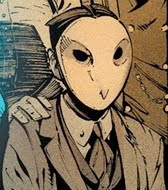
Wet was described to me as Grindhouse the game. Which more or less assured I would go buy it immediately. Unfortunately, Wet isn’t really Grindhouse of say Tarantino and Rodrgiuez but the faux Grindhouse style of Nevedile Taylor, Neil Marshal in Doomsday, Rob Zombie sense of the word. A description that may have you running towards the door. Its kind of the videogame equivilant of Black Lagoon, market tested to be edgy, dropping F Bombs, blood, and bizarre character design with non stop frequency and exactly zero impact. But I can appriciate the effort.

Its funny far from simply reveling in it which I expected to do, Wet made me remember the pleasures of giving my internal film nerd the night off every once in awhile. When the intertitle showed a William Castle style warning, followed by a seventies title, and then a promise of an appearenance by Bela Lugosi. My mind first recoiled, protesting “But… But.. that’s clearly mixing three different era’s of exploitation cinema aesthetics. Couldn’t they do a little fucking research?” Only to have the much more sensible part of my brain respond. “Shut the fuck up, and enjoy this goofy as hell, fun, violent pastiche” I was happy to take its advice. How much you enjoy Wet will greatly depend on how responsive your brain is to being told to shut up and have a cookie.

The game is definitely designed more for how it looks then plays. This is excusable mostly because the control is simple, and the game looks good. But when I’m engulfed in flames because the animation on the bar flips has to be perfect, it becomes a problem. Combat is fun, except it penalizes you for using your sword by taking away bonus points for your lack of “acrobatic kills”, which is problematic as the sword is a lot more fun to use then the guns. Still aside from an overlying reliance on quick time events the mechanics of the game are sound.

Similar to Black Lagoon, the only thing I can really think of that matches it in tone, The game tries so hard to be KEWL!!! and Totally Xtreme. That it is never cool, or for that matter totally extreme. Its Poochie in videogame form clearly the product of committee think (though what committee thought exploitation film fans was a market to go after. Or for that matter a demographic with any money, is beyond me.) rather then passion.

Look I’m pretty bad at videogames. Whenever I play First Person Shooters with friends they think I’m drunk. My brother and sister regularly school me at Mario Kart where I look like an advertisement for MAD. I can’t even play a relatively simple party game like the new Mario Brothers Wii game without looking like a fucking travesty. Most of the reason I’ve avoided the online revolution in games is to hide my shame. And I beat Wet on hard mode in a matter of hours. This game is either absurdly easy or I’m a fucking savant at it. I’m willing to bet on the former. This might be good for me, but for the more hardcore among you, you might be looking at a very short game.

The film brings in Malcolm McDowell, Alan Cummings, and Eliza Dushku, playing of course Eliza Dushku.

For what it was I thought Wet was fun. The question for you is, is what it is enough?

Friday, May 7, 2010

The Young Dragons


John Woo has become a depressingly easy director to underrate. Its no secret by now that John Woo’s American career has been, to put it kindly, a disaster. A depressing mélange of missed opportunities, watered down whoring of his talents, and good ole fashion hackery. The entirety of his 15 years wasted in Hollywood yielded one film, that is kind of entertaining despite being a total camp fest (Face Off) and one film that had potential but should have been a whole hell of a lot better (Windtalkers). The rest is too depressing to delve into, I’ll just say that when your second runner up stars Jean Claude Van Dam your career has problems.

Meanwhile outside of Woo’s own doing, his style which started out so refreshing ended up first being subsumed and replicated by hacks ad nauseam, and then cast aside for the Greengrass touch. Either way, he’s awfully easy to discount nowadays.

But this doesn’t wipe out all the great films Woo has made. Bullet In The Head, The Killer, Hard Boiled, A Better Tomorrow. These films are still legendary among action fans and with good reason. His borderline high camp style, masochistic story lines, and incomparable eye still make him an essential filmmaker. A Frankenstein’s monster, equal parts Douglass Sirk, Bubsy Berkley, Jean Pierre Melville and Sam Peckinpah.

Still, there are signs that Woo’s reputation is back on the rise. Though I haven’t seen Red Cliff yet (I’m waiting for the money to pick up the Blu Ray and refused to see the truncated American cut) I hear it’s a return to form. And Kickass gave him a very generous name check. Turning his films into essential training for the budding young sociopath. Having never seen the film name checked by Big Daddy and Hit Girl, I decided to check out Woo’s first film The Young Dragons.

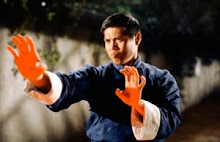
So famous is he for the Heroic Bloodshed style, that few know that Woo started out as a kung fu director. And a damn good one at that. Depending on the day you ask me, I might say that his Hand Of Death (starring a young Jackie Chan) is my favorite Kung Fu film period.

The Young Dragons, isn’t quite there yet. Woo’s style hadn’t quite crystallized. It’s not a perfect film, but its also one with clear signs of who Woo would become, and is thus worthwhile for any serious fan of the director. A flawed film but a rewarding one.

I’ll admit. I had a hard time following this movie. And I mean that in a very basic way, as in who the characters were half the time, and what their base motives were. Its not like the story is super complex or anything in fact I’m almost embarrassed about it. But there’s a real confusion to the storytelling that makes it plain difficult. Now granted this is not all the movies fault. This film has the classic old foreign film fuck up of printing its subtitles in white before displaying them in front of white backgrounds and costumes. Meaning forty percent of the dialogue is lost. And what dialogue does make it through is atrociously translated (not that I’m complaining per se, The Young Dragons hasn’t been, strictly speaking, released in The US. I was just happy to get my hands on a copy. Beggers can’t be choosers and all that.)

While there are no flying doves, tongues of flame, or rains of bullets, its clear from the beginning that Woo had a talent for action. While there’s nothing quite as batshit insane as say the ending of A Better Tomorrow II, Woo shows a real talent for interesting composition, choreography, and a skill for challenging himself. While most martial arts directors keep the camera stationary to make choreography easier, Woo moves it in sweeping tracking shots, bringing it into the midst of the action while keeping his lucidity. He finds interesting ways to shoot things, perpendicular from how you would expect them. At one point he shoots a battle with the camera pointed directly at the sun, blowing out the frame save for the principles silhouettes. At another he chooses an ultra wide shot, for an impressive cliff dive, rendered even more impressive by the fact that we can clearly see there is no sort of safety net or trickery here.

Woo’s taste for Masochistic Melodrama already in full flower. The movie is clearly a heroic bloodshed movie wherein the heroes just happen to kill each other with their bare hands rather then pistols. Most the heroes die tragic deaths, leaving the survivors to stare at their bloodstained corpses, getting chocked but because of just…how…beautiful they where.

Hey come to think of it that’s more or less an apt metaphor for Woo’s directing career.

Thursday, May 6, 2010

The 25: Part 8: For A Few Dollars More

(The twenty five is an examination of the twenty five films that made me a cinephile. These aren’t necessarily what I consider best movies, nor are they necessarily my favorite. Though in some cases they are both. Instead these are the films that made the biggest most indenialable impression on me. Films that if they hadn’t hit a certain way at a certain time I would not be the same film goer that I am today. They’re the twenty five.)


I can’t think of another foreign filmmaker I knew before Sergio Leone. Despite the presence of Eastwood, Leone’s films remain so distinctly alien from their American counterparts, that they make the transition for the budding film fan easier. Familiar genre, sure, familiar stars yes, but the tone and style is so different, that they might as well be transmissions from Mars.

My Father loved the old Westerns, the works of Hawks, Ford, and Hathaway. It wasn’t until later in my film going life that I was able to appreciate those films for the poetic masterpieces that they were. Despite the fact that as a kid I had an unusually high tolerance for older film, at the time I was merely bored, and wondering why we weren’t watching a Sean Connery Bond instead.

The Leone movies though, those were different. Savage, stylistically, grimy, and funny. Wild in the way the other films weren’t.

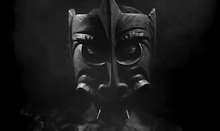
I don’t know if there’s an opening shot to a movie I like better then For A Few Dollars More. Unconnected to the main narrative of the film, an unknown man rides on the plain, an unseen rifleman draws a bead on him, and blows him off his horse. Which run’s neighing across the plain before exploding into a stark Red and White animation as Ennio Morricone’s score comes in.

You now have my attention.

While it might not have anything to do with the film’s story it sells the tone plenty. Leone’s world is harsh and unforgiving and death is cheap and undignified. John Wayne never rode here.

For A Few Dollars More is often seen as the least of Leone’s Man With No Name Trilogy. But its my favorite of the three. Operatic where The Good The Bad And The Ugly is mythical. Expansive where Fistful Of Dollars is Claustrophobic, For A Few Dollars More strikes the perfect balance in the series. While making room for a great performance as Lee Van Cleef, as the hard vengeance seeking hero Colonel Mortimer. Van Cleef controls every scene he’s in with an unfakeable hardness, and competence. Introduced stopping a train for his own convenience before hunting down a bounty with his wonderfully preposterous, borderline fetishtic rifles, in a fantastic scene.


All around this has to be one of the best cast Westerns ever made. Even Klaus Kinski shows up for the fun, in a performance that impressed me before I knew I should be impressed. It’s a small role but he steals every shot he’s in as a walking twitch of a man with a hunch back, who seems .2 seconds from going off at any given moment. The moment where Van Cleef casually strikes a match off his face, daring him to break rank and do something about it, is one of the tensest in the film.


Indio, played by Gian Volonte, returned from Fistful and playing a much more effective bad guy then the dandyish Ramon in same, is still one of my favorite villains. Savage and brutal, but elegant and thoughtful as well. A self reflective monster with just the right touch of sadness to him to make him scary.


But really it all comes down to Clint. Far from the clean cut heroes of the American Western’s The Man With No Name is a harsh, sneering, badass with a fully developed anti authoritarian streak. Watching him bust down a corrupt sheriff after doing his job for him, is a rare joy. He inhabits every scene with a swagger, dominates every conversation and gun fight with confidence and ease, and yet seems strangely vulnerable before Leone’s lens. For all his iconic glory there always seems that possibility that The Man With No Name will meet his match. He never knows all the angles he just thinks he does.

Its not just the actors in top form. Morricone’s score, sparse and haunting is one of his greatest. Particularly the central pocket watch theme which ends up at the core of most of the films major sequences.

Leone’s in top form as well. The film contains many of his best sequences. The eerie early morning prison raid set to Morricone’s tolling bell. Indio delivering his parable from the pulpet of the abandoned church, gives a normal “master plan” sequence a delightful satirical edge. The final showdown with Indio’s gang, both the town clearing shoot out which is some of the greatest action Leone ever shot, and the final showdown between Mortimer and Indio which is right up their with the climax of The Good The Bad And The Ugly for sheer tension. Clint in the aftermath piling his bounty of bodies on his mule cart adding up his winnings with ghastly good humor.

Its no secret that Leone’s greatness comes from his oft parodied ability to stretch a sequence far beyond its natural limits. But its not just his famous shoot outs that employ the technique. Take for example the scene in which Indio’s troops scope out the bank, counting how long it takes for the guard’s to make their circuit. A normal director would have left it at that, having delivered the exposition that the gang have cased the bank. Leone stretches out the scene as long as it can go. Cutting to each gang member (and our heroes) as they count off the guards steps. In the process he makes the scene unforgettable.

Despite the number of films I’ve seen since For A Few Dollars More, its wonderful odd foreignness still exists. It has a structure and a tone nearly unrecognizable to when compared to the Robert McKee school of act driven screenplay. Take the comic interlude involving a lusty properties of a hotel and her nebbish dwarf of a husband, which Leone lets play out beyond all reason. The effects charming, like watching a small comic interlude between the plays at a Vaudeville house.

Despite the effect on me, I can’t pretend that For A Few Dollars More made me run out into the street demanding fast helpings of world cinema. But it was a start. Others would come and build on that start, which we will come in their own time.

At the time For A Few Dollars More is what it remains for me today. A Ferociously entertaining film directed by a master and starring one.

Wednesday, May 5, 2010

Wes Anderson From Both Ends: Bottle Rocket and The Fantastic Mr. Fox


“They’re not going to catch me. Because I’m a fucking innocent!”

Wes Anderson is one of those directors who I don’t merely value but cherish. His unique voice, melancholy, delicate, whimsical in the best manner, and ever so slightly aloof, is one I can imagine cinema without. But its not something I like to do. Like the Coen’s his absence would leave cinema a much unhappier place.

There’s a definite divide of opinion on Anderson, between those who love the ever increasing specificity of Anderson’s persona (This is a director who makes Credit Card commercials more personal then most films) and those who wish he’d crack a window on his hermetically sealed world and let some air in. Though, after the unfair shellacking that The Darjeeling Limited received, Anderson’s warmly reviewed The Fantastic Mr. Fox, seemed to find the critics mostly back on Anderson's side.

The film that most of the detractors of his latter day work point to is Bottle Rocket. And it is beginning to look like something of an anomaly in Anderson’s career. Not so much in tone, but in a certain loose limbed spontaneity. There’s a certain sloppiness to the film, but a certain life that counter acts it.

While one could argue that Rushmore takes place in as much of a “real world” as Bottle Rocket. The key difference being that Rushmore is a film about a Wes Anderson Character colliding with the world, Bottle Rocket is a film about the world colliding with a Wes Anderson character.

Bottle Rocket sets its tone early with Luke Wilson “escaping” from the mental hospital he’s been residing in, under the supervision of the staff (“Everything about this looks bad.”). Its soon revealed that Wilson is participating in this farce to satisfy his friend Dignan, played by Owen Wilson. Dignan devised the plan and Wilson didn’t have the heart to tell him that since he checked himself in, he could go ahead and check himself out.

Dignan has a plan to get Wilson, and their friend in with a local “crew”. After robbing a bookstore for a paltry take, they go on the lamb as the start of Dingham’s sixty year plan. Like all Anderson’s protagonists, Dingham has a very specific idea of what the world should be. Unlike with most Anderson characters, the world refuses to play along.

We all know guys like Dignan. Hell I know a whole bunch. Guys who are always talking about the big plans they’ve had, and the connections they’ve made, and how it will all come together, with that same hopeful smile in their voice no matter how many times it doesn’t happen. And after you know these guys awhile you just plain stop believing them. But you never have the heart to tell them that. I mean how could you?

Because the thing is, that if you were ever to tell the Dignan’s of the world that their plans will not bear fruit, it wouldn’t be their heart you were breaking but your own. Because if someone who believes, and hustles and plans, with such faith and ferocity can’t get their dreams off the ground, well then where does that leave you and your dreams? You may not believe in Dignan, but you let him think that you do, because doing so allows you to believe in yourself again, if only for a little while.

Bottle Rocket doesn’t feel quite like any other Anderson film (No other Anderson film could star James Caan). Its looser more ramshackled, comparable to the work that Jaramusch and Linklater were doing at the time. But the filmmaker who Anderson would become is just under the surface, breaking through with Wilson’s halting romance with a hotel maid and the sequences set to The Proclaimers “Over And Done With” and The Rolling Stones “2000 Man” which showcase Anderson as one of the most arresting combiners of image and music working today.


It is true as people say that the filmmaker who made The Fantastic Mr. Fox could not have made Bottle Rocket. But it is just as important, and a great deal more ignored that the director who made Bottle Rocket could not have made The Fantastic Mr. Fox. Anderson has found his particular, peculiar voice as an artist and why so many wish to penalize him for it is rather beyond me.

Its true that The Fantastic Mr. Fox took me a little longer to digest then any of his other work. I wasn’t expecting the film, its tone is singular even by Anderson standards. And Mr. Fox himself was so strangely determinedly imperfect. Don’t get me wrong I liked it enough to name it as one of my top ten films of the year. But even though I knew I liked it, I wasn’t quite so sure what I thought about it.

The answer perhaps comes in the technique. Animation would seem to be the ideal medium for an artist as meticulous as Anderson. But while some insist that the “just so-ness” of his frames, I find it downright cozy. From the opening frames, of the exact copy of the book I used to own no less, to the film’s autumnal feel, The Fantastic Mr. Fox is a supremely inviting film. Filled with all sorts of agreeable digressions and animated with a lively spirit, while keeping a brisk runtime. This is a film barely over eighty minutes that still finds time for a scene like this.


Like Anderson himself everything is delightfully singular, from Michael Gambon’s deliciously nasty villain (though Gambon always seems to have a sinister edge to me no matter how nice he’s playing) to Willem Dafoe’s rat, who is played so close in vocal styling’s and mannerisms to Dafoe’s infamous Bobby Peru that I refuse to believe its accidental. It’s a film which rejoices in the odd detail (Mrs. Fox’s paintings) and the unremarked upon joke (“Love Is All There Is” the theme song for Disney’s Robin Hood continuously playing in the background) and unexpected callback (Kristopherson’s repeat of the karate scene in Bottle Rocket, this time by a character who is very Andersonian.)

Its easy to want to strip Anderson to his elements. His anglophilia, urbanity, melancholy, dry wit, impeccable ear for music and subtle poetry. But there remains something elusive and inexplicable about Anderson’s work.

Take the scene where the three greedy farmers procure their steam shovels, and we’re treated to the sight of the cackling minature Bean pulling the various pulley’s and levers in his cab like he’s Marvin the Martian prepping to blow up Earth. Set to the utterly unexpected yet somehow perfect, Street Fighting Man. How else am I to react to such a specific and wholly unexpected image, but with delight?

So too, Anderson himself.

Tuesday, May 4, 2010

Zoe Saldana: The First Post Racial Movie Star?


Terms like Post racial don’t seem to be much more then empty buzzwords to me. But with Zoe Saldanaa, there seems to be quite a bit of truth to the term. No two ways about it she’s had one hell of a year and if she keeps doing great work in great films, there seems to be no reason why she can’t become the type of crossover star that Angela Basset, or even Thandie Newton was unable to become.

I saw two very different sides of her talent in the theater last week, where she ended up the bright spot in two very different films. But in both cases she proved herself a funny, exciting presence, a singular lanky look, with no small amount of sex appeal and charisma to burn, equal parts likable Tomboy and glamour girl.

Which really sums up the whole of the cast here. The film’s characters are none too deep but coast by on a likable mixture of charm. Chris Evans, like James Marsden (hey!) Proves once again to be one of Hollywood’s secret weapons. Jefferey Dean Morgan, who I’ll admit I’d never noticed before his flawed (I still think the role needed someone older) but committed turn as The Comedian in Watchmen, holds things together, with a mix of machismo and flat out charisma. He’s like a less annoying Burt Reynolds (or maybe its just the righteous stache). Jason Patric channels Sam Rockwell with all his might as The Loser’s nemesis. The only odd man out is Roque who displays non of the intellgence and danger that he did as Stringer Bell on The Wire, and instead just comes off as kind of dumb.

Its by no means a great film, or even that great of an action film, I can’t think of another Popcorn movie that so strenuously removed the consequences of violence from the screen. Everyone always has a reason not to die, despite the Losers firing their many many rounds of ammunition. And when shit finally in the parlance of Michael Bay, Gets real. Anything disturbing is kept conspicuously in long shot.

The whole thing has the agreeable air, and deliberately small scale of a classic Programmer. One could easily see Sam Fuller or Walter Hill cranking this out in (an off?) days gone by (though it would most likely be a more memorable affair). Still the director of freaking Stomp The Yard aquits himself well here. And even if I’m not exactly chomping at the bit for him to make Ronin, that has more to do with the fact that I don’t think anyone whose name is not Alejandro Jodorowsky could bring Frank Millar’s lunatic vision of Escape From New York, meets Sword Of Doom, crossbred with norse Mythology, Nanotech nightmare to the screen, then anything personal.


There is however, a lot I take personal in the Neil Labute’s risible remake of Death At A Funeral. Oddly enough I’m usually something of a LaBute apologist (if not a fan). I feel like people are too eager to use the worthlessness of some of his later films, to discredit Your Friends And Neighbors and In The Company Of Men, because those films frankly make them uncomfortable. But this any more like this and I might have to join the choir.

Because say what you will about him, but LaBute is not a funny man. And he takes what I genuinely think is one of the best comedies of the decade and wrings all the laughs out of it with a thoroughness that is nearly neurotic.

It’s a stupefying poorly done film, any laughs in it purely residual. Chris Rock (who should have directed), Tracy Morgan, James Marsdan, and of course Ms. Saldana are all talented performers. But they just don’t find any fun or interesting way to tackle the material. Even the ever dependable Pete Dinklage overplays in his second turn as the character. The film also fails to land any of the movies big emotional beats.

On the whole the film has the joyless rote feeling of a vaudvielle company on the hundreth night of a tour, staring at the audience with contempt.

It would be the worst movie of the year so far, had it not been for Nightmare On Elm Street.

Monday, May 3, 2010

Stuff I've Been Reading: April

Books Read:
-Fury, Rushdie
-Film Flam, McMurtry
-Ask The Dust John Fontaine
-Hellbound Heart, Clive Barker
-The Colour Of Magic, Terry Pratchet
-The Big Short, Michael Lewis
-Orthodoxy, Chesterson
-The Collected George Orwell, Orwell
- Batman 100


Fury, Rushide

For whatever reason, most likely dating back to an aborted attempt to read Satanic Verses at thirteen I’ve always considered, and avoided Salman Rushdie as difficult. So I was surprised and gratified to find that far from impossible Fury reads like a Chuck Palahniuk book for grown ups. A delirious vibrant rush that manages to be nearly joyful in its headlong plunge through vernaculars, emotions, and genres.

It also has the strange honor of being perhaps the final pre 9/11 New York novel any worth.

Fury follows Professor Solanka, living in New York in self imposed exile after being suddenly possessed by a murderous urge to kill his family. It’s a kaleidoscopic cut and paste vision of the city and existence, often fitfully funny despite its dark nature. Rushdie’s writing is savage and blunt, while at the same time elegant. Fury is a frankly visceral book. It gets in your guts, yet it always leaves times for the odd life giving aside, such as a dissertation on the nihilism of Panglossianism and a detailed summary of a sci fi multimedia experience the professor creates and unwittingly ends up fueling a despotic regime in the third world.

Though it juggles so many threads and styles and stories it is perhaps inevitable that Rushdie is not able to bring them all to a satisfying conclusion. The book ends anticlimactically as such mélanges tend to do.

It doesn’t matter. It’s a thrill watching him try.

Midnight’s Children is next.


Film Flam, Larry McMurtry

Another mislabeled bit of latter day McMurtry. What is purported to be a book of film criticism is really just some tiresome dishes on the behind the scenes process, with a few half assed ill considered pieces of criticism thrown in. Leaving me with nothing more to chew on then wondering just what the hell McMurtry was planning on writing his third Memoir Hollywood about. As he has already covered things pretty extensively here, My guess is city planning.

Its more or less readable, McMurtry is seldom less, but that’s depressing none the less when he can also be something more.


Its not John Fante's fault that he captured the character of the sexually confused, do little, self regarding hipster douche bag with what can only be termed astonishing precision. But capture it he has, eighty years early. Which makes the book a considerably less exciting experience then it must have been seventy years ago.

I am aware that Bandini is supposed to be a romantic figure, but when watching him make racist comments, rail against the evils of marijuana addiction and curse the world for not recognizing his genius, I was only seized by the fact that I would not want to share so much as a cup of coffee with the man.

Fante's writing has a certain flair to it of course, and his descriptions of the Long Beach quake and old LA are arresting.

Yet it is inexorably tied to a hero and a doomed love affair (He calls her a spic and a dirty beaner! She gets offended and sets his writing on fire! Its Magic!) that seem now, not tragic, but merely faintly ridiculous.


And hey while we’re talking about better in theory then in practice here’s Clive Barker. I cannot quite put my finger on why he and I fail to connect, its not for lack of trying. But it is doubtless we do not.

Hellbound Heart is the source material that Barker’s Hellraiser is based off of. Barker actually made some very smart choices in adapting his work making it one of the rare cases where the film is better then the book.

The book is a slight thing, and more obviously a Lovecraft pastiche then the movie (Lots and Lots of non Euclidian geometry.) The Cenobites appear even less then in the novel then in the film, and are hardly described (again Lovecraft) coming nowhere close to the startling imagery of the film. Barker, was smart also to shift some of the relationships in the film.

Its pretty clear that Barker pretty much doesn’t give a fuck about "normal" people. Which is a shame because he is so often obliged to write about them. The main shift the book makes is in turning the protaginist from the unlucky Frank’s would be lover, to his daughter. The reason this works so much better is that Frank himself is painted by Barker as such a drip. And as Kristy’s defining characteristic is she wants to be with Frank, we have a character who is defined by the fact that she has an all consuming passion for a man that both the audience and author find pathetic sop.

Not the strongest character trait.

Still it’s a quick read, and interesting if only for the insight it gives into Barker’s authorial development. At a hundred and fifty pages there’s not a lot to lose.


As I’ve mentioned before in my column I have a thing about starting series from the beginning, no matter how tangentally the books are linked to each other, that is almost pathological.

Which may explain why I never have really gotten into Discworld no matter how many times people have exasperatedly explained to me that it really doesn’t matter what order you read it in. I just can’t help it.

So it was a bit of providence when I came across The Colour Of Magic at the Oakland Museum rummage sale, with the bold letters across the top proclaiming “THE FIRST DISCWORLD NOVEL”

And even though I’m told it’s a weaker entry I found it a charming breezy experience, and eagerly await my return to Pratchett’s fractured fantasy world.

The Colour Of Magic follows Rincewind, the most cowardly wizard on the disk as he becomes the unmeaning steward of a “tourist” who comes to the savage area of the Disc seeking adventure and whore pits. Disaster soon strikes, more or less continuously as do the gags and asides and to get a bead on the tone try imagining your typical fantasy novel with Daffy Duck as the hero.


Of course one can’t very well write about Discworld without mentioning the tragedy that has befallen Pratchet. Afflicted with a rare form of early onset Alzheimer’s, that is frankly just heart braking even to consider. Pratchett has put on a brave optimistic face on the matter, but the idea of a mind as alive and full as his cannibalizing itself is unbearably sad to me. I can only offer my thoughts, good wishes, and prayers. Which isn’t a lot but is unfortunately the best I can do.


Writing a Batman in the future novel is kind of zero sum game, as the book on that particular subject has already been written. I believe that The Dark Knight Returns is one of the most perfect pieces of pulp fiction ever written. That’s not a misprint that’s not hyperbole, that’s fact. Nothing, not Miller’s ever increasing batshit crazy work (which I think has more merit then is given credit for. And is not so as out of line with his former work as most critics would have you believe. But that’s another essay.) not the disastrous sequel can change that.

Paul Pope seems to realize this. And sets about telling a compact, almost small scale, story of Batman in a Totalitarian future, doing what he does best. The story is a bit muddled, and though pope brings up interesting ideas (Like Batman being a V For Vendetta like construct of several people by this point) he doesn’t really explore them in any meaningful way.

Where Batman 100 really shines, is in Pope's art, which manages the uneasy task of being both hyperstylized and hyper lucid at the same time. The grace with which Pope’s artwork flows from panel to panel is difficult to articulate. It’s the kind of thing you really have to see for yourself.

Whatever Flaws Batman 100 has as a story, as a piece of art celebrating an icon that seems eternal, it’s a roaring success.


A Great read that is unfortunately also completely terrifying. Like The Smartest Guys In The Room, another tale of corporate malfeasance that happens to make a great noir film, I kept shaking my head in equal parts dismay and delight all throughout The Big Short. It would be an awesome story if only it wasn’t true.

Lewis is a canny financial writer, and he’s able to draw a clearer portrait of the financial collapse then any I’ve seen, meaning I was only unable to understand about 75% of what was said rather then 90%. But Lewis is also a great journalist, and he knows that even if the financial landscape he paints is unclear his portrait of greed, sloth and stunning willful ignorance is crystal.

The way Lewis tells it, The finacial calamity was the result of nothing less then everyone on Wall Street, Brokers, Bondsmen, CEOs, Regulators, Banks, all simotanously shoving their fingers in their ears and screaming “LALALALALALLALALALALALLALALAAAAAA!!!!” for half a decade. It’s a simply jaw dropping depiction of idiocy and corruption on a massive scale.

Lewis enginiously shows this from the side of the view people who saw what happened and in the best Wall Street Fashion decided to make some money off of it. In all fairness to Lewis’s heroes, they where trying to warn people as well. Time and time again Lewis documents conversations that go.

“You are going to lose all your money, and I am going to be the one who takes it from you unless you wake up to the fact that your entire finacial system is a sham.”

“No its not.”

“No you don’t get it. Your entire system is going to burn down in a couple of months and I’m going to be the one collecting on the fire insurance. Go get a hose. Now.”

“Nope don’t think I will.”

It’d be repetitive if it wasn’t so horrifying. If you want to know why you and your children’s children are going to be living in a bankrupt country. You owe it to yourself to read The Big Short.


Orthodoxy is arguably Chesterson’s most famous work as a Christian Apologetic. Its interesting anomaly in the genre though. While most of Apologetics focus on how the rational mind can believe the irrationality of Christianity, Orthodoxy focuses mostly on how Christianity works as philosophy. Using the contradictions that most critics point to as faults into the religion and turning it into boons. Christianity’s ability to embody two seemingly conflicting ideas and embody both fully is given a wise and interesting look.

It’s a thoughtful considered approach, that embodies Chesterson’s intelligence, warm wit, and gentle humanism.

It also more or less fully encapsulates all the things that bother people about Chesterson. His dismissal of Eastern Religions, his unwillingness to find fault in the church, the line he all too often crosses from apologetic to a man with genuine blinders on, as in one line where he seems to suggest that The Spanish Inquistion wasn’t as bad as all that. In one interesting line he compares the Christian view of nature to the pagan one, pointing that St. Francis wrote of nature as a little sister. Which gave me pause and made me think, well yes, but one is not often in the habit of raping and exploiting our little sister.

But this all goes to show that Chesterson lived in a simpler time. Mistreating nature meant building an unclean textile mill, not global warming. I have more then once wondered what Chesterson would have made of the scandal that has befallen his beloved church these days. And the answer came that I simply don’t think he would know how to handle it.

The thing about Chesterson that never fails to impress me, is how polite of an author he is. Oh he’s forceful, but keep in mind that he was a contempary and good friend of Shaw, Welles, and Wilde. That he held views diametrically opposed to them, and often called them out in his writing, mattered little, that core of friendship, and fascination held. Disagreement was an opportunity to strengthen and examine ones beliefs, not hate the other person for having him. Sadly in the era of the tea party and Fox news, perhaps nothing else marks Chesterson as so much the relic.

While Chesterson is an author I cherish, and I mean that word fully. He is an author of his time. We have to take the wisdom that we can get from him, enjoy it with the talent that he portrayed it with that never will grow old and except that we must in the end find the answers for ourselves. Take what we can and leave the rest.


The Collected Orwell, George Orwell

In speaking of which…

“Saints should be considered guilty until proven innocent,” Orwell said in one of his finer moments. He more then anyone would be horrified by the hagiography that’s been committed on his own self.

1984 and Animal Farm are both such powerful prescient work, that they tend to block out the rest of Orwell’s writings as surely as an eclipse. Disguising the more difficult and all the more satisfying author within.

Orwell is not a plaster saint. If anything his authorial voice resembles a drunk libertarian patiently explaining why everyone else in the world is an idiot. To call Orwell pendantic is not to do him justice. Take for example this segement taken from the essay “Inside The Whale and Nick Hornby’s priceless reaction to it.

First Orwell:

“To say that you accept in an age like our own is to say that you accept concentration camps, rubber truncheons, Hitler, Stalin, bombs. Aeroplanes, tinned food, machine guns, putsches, purges, slogans, Bedaux belts, gas masks, submarines, spies, probocateurs, press censorship, secret prisons, aspirins, Hollywood Films, and political murders.”


Now Hornby:

Isn’t it possible to accept, say, tinned food, Hollywood films, and asprin without accepting Stalin and Hitler? I’m afraid I am one of those cowards ho would have happily invaded Poland if it meant getting hold of a couple of pills to alleviate a hangover. And what is wrong with tinned food, that all these guys banged on about it so much? (…) It’s true of course that fresh fruit is better for you. But one would hope that, with the benefit of hindsight Orwell would conced that Belsen and the purges ranked higher up the list of the mid twentieth century horrors then a nice can of peaches.

The whole book is full of stuff like that. In his essay on Dickens Orwell seems baffled by the fact that Dickens was neither pleased by society, nor wanted to burn the entirety of it to ashes. Well yes Georgie, there’s a word for that mindset, its called a reformer. Surely you must have come across the word at some point?

And yet it is precisely these contradictions that depth of feeling. That unwillingness to grade the horrors of Belsin over the indignities of a can of peaches that make Orwell such a fascinating and vital writer still. He may have some wrong headed ideas, true he seems to genuinely believe that machine labor can create a utopia, an idea that was out of date when HG. Welles was writing. But I, unlike Hornby, feel that he still has a great deal of influence. Its impossible to read something like Shooting The Elephant without thinking of our misadventures in Iraq and Afganistan.

And one passage of his, that has haunted me since I first read it many years ago,

“At this moment, a man presumably carrying a 
message to an officer, jumped out of the trench and ran along the top of 
the parapet in full view. He was half-dressed and was holding up his 
trousers with both hands as he ran. I refrained from shooting at him. It 
is true that I am a poor shot and unlikely to hit a running man at a 
hundred yards, and also that I was thinking chiefly about getting back to 
our trench while the Fascists had their attention fixed on the 
aeroplanes. Still, I did not shoot partly because of that detail about 
the trousers. I had come here to shoot at 'Fascists'; but a man who is 
holding up his trousers isn't a 'Fascist', he is visibly a 
fellow-creature, similar to yourself, and you don't feel like shooting at 
him.”


If that one ever loses its truth we are all good and fucked.

Saturday, May 1, 2010

Long Week On Elm St.: Part 9: Nightmare On Elm Street


I’m sorry.

I’m sorry that I gave this movie a moments free publicity not to mention over a weeks worth. I’m sorry that for one moment I thought that Platinum Dunes could perhaps produce something decent, despite mountains of evidence to the contrary. I’m sorry I defended and doubted. I’m sorry that I entertained the hope this could be worth a shit. And most of all I’m sorry to you. If I for one second got you excited or hopeful or interested in seeing a new Nightmare On Elm Street Movie. I’m sorry.

I fucked up.

This is one of those frustrating movies where all the elements are brought together for something that could be decent and nothing comes of it. Jackie Earle Haley is obviously trying here, but he has no material to work with. Wesley Strick provider of said material, can obviously write a good horror film, or for that matter a remake of a horror film that manages to be unique and interesting while still fundamentally respectful to its source. But nothing ever comes from this anemic movie. Its stuck on second gear.

I could treat this like a normal review; go into the problems and shine a light on the (very) few bright spots. The flaccid script, utterly unlikeable cast (how Nancy despite the fact that she has a delightful Sarah Vowell gurgle of a voice and is in all honesty just my type derived no sympathy for me) the utterly mind boggling leaps in logic that the story makes (some would accuse me of over analyzing but really is that the point where we’re at? Where we just genuinely don’t give a fuck about logic and craft?) but that would be raging at the cure and not the disease. Which is precisely what this movie is. It’s a fucking disease.

Look say what you will about Rob Zombie’s Halloween, but at least there’s some kind of vision there. It might be a vision you detest, but there’s an idea there. Like The Depressing Friday The 13th remake the vision all too self evident. “Lets stick this fucker on autopilot, remove all the charm, and hope these dumb fucks give us their money.”

I can’t even get rightly mad at Michael Bay and his stupid fucking Morlocks at Platinum Dunes. Fool me once shame on you. Fool me twice, shame on me. Fool me three times and you fully deserve to think I’ll get fooled again.

But I won’t. I’m done. I’m out. I’m never giving my money to these fuckers again. And whats more, unless there’s some excellent evidence that there’s a reason to, I’m never watching a remake again. We can bitch and we can moan but the fact is, that as long as we put up the money and give them the attention. The studios have no reason to stop shoving these down our throats.

So stop doing it. Stop going. Just stop.

What a waste. What a waste of time, and talent and fans passion. What a depressing useless waste. This movie is utterly bankrupt.