Showing posts with label Stephen King. Show all posts

Monday, November 1, 2010

Stuff I've Been Reading October


“Tessa’s feet were screaming in her fasionable boots.”

This sentence, dropped in the middle of a chase scene involving dozens of vicious automatons, apropos to nothing, should let you know all you need to about Cassandra Claire’s immense deficiency as a writer.

In my line of work it behooves me to keep abreast of at least a few YA titles. So when I came across Clockwork Angel, I realized “Hey I like both Victorian London and Eternal Battles against the Darkness! How bad can this be?” Hoo boy.

The blending of Victorian and Occult fiction is a natural one. Both depend upon the thrill of the hidden society concealed within the world. Wheels within wheels powered by arcane codes of conduct.

Anyway the story is the usual mumbo jumbo of a young girl caught in between the forces of darkness represented by blah blah blah. The point is she soon ends up predictably caught between two life support systems for abs and we go on from there.

All the usual flaws are here, characters who range from vapid to merely dim. A plot we’re several steps ahead of at all times. Writing that’s declaritive and dull (It doesn’t help that Claire makes the decision to start each chapter with some of the finest lines of Victorian verse. Reminding our poor brains what good writing does look like) and Banter that is jarringly contemporary.

But here’s the real bad news. There are scenes here, isolated though they may be. That actually suggest Claire could become a good writer. A scene where our young heroine stumbles into an abattoir where the corpses of the innocent are being fused with machines, are written with a vividness that suggests a dark and fertile imagination that Meyer’s and most of her ilk never had.

Should Claire ever shrug off her bad habits it’s possible she could become a hell of a writer.

As she has already been amply rewarded for those bad habits, that seems rather unlikely.


I have begun a delightfully unexpected late in life love affair with Ray Bradbury.

When I was the age when most discover Bradbury his indirect florid prose frustrated me. And to a certain extent, say in something like "Jack In The Box", it still does. But setting aside his stylistic ticks Bradbury is one of those treasured authors who marches in no one’s territory but his own.

Most of the stories in October Country aren’t quite horror, fantasy or sci fi, though some like The Small Assassin would fit quite comfortably. Most just hum along on a kind of all American wrongness. A feeling like you’re conversing with Will Rogers after ingesting a few tabs of acid.

The Halloween Tree exists on the same inimitable plane. It’s hard to imagine a children’s book with scenes as intense as the children’s encounters with Samhain and it’s grisly aftermath being released today. At least not without the school board getting buried in letters. But The Halloween Tree maintains a feeling of good natured malice, if not comprehensibility.


Yeah I’m pretty sure I dug this one.


Squirrel Seeks Chipmunk finds David Sedaris in an unusually vindictive mood. Though there are few writers better at ripping apart people behaving badly, Sedaris more vicious tendencies are usually countermanded by his inherent amusement and affection for people.

He apparently feels no such need when faced with animal characters, and most of his stories quickly fall into levels of bad behavior and misanthropy which are Ellisian. Things pick up a little at the end, when Sedaris lets up on his targets just a little. And his prose is witty and graceful as ever. But it can’t help but all feel more then a little pointless.

I was lucky enough to attend a reading of Sedaris earlier in the week, where he read a few stories. And as expected they worked much better (though unexpectedly, despite what his persona may have you believe Sedaris is borderline gregarious in person. He also drew an owl in my copy of Me Talk Pretty One Day. I have no idea of its meaning and it haunts me) Sedaris reading of his own material has always been as much a key to his success as his prose itself, if not more so. And Squirrel is no exception, in this regard. But perhaps it is an exception as it is the first of his works that cannot stand without it.


Bill Bryson an author of boundless curiosity, humane temperment, lucid civilized prose and a lacerating dry wit is one of the most purely pleasurable authors I know of. A Walk In The Woods is of course, no exception, and arguably his masterwork.

The saga of Bryson’s attempt to walk The Appalachian Trail, A Walk In The Woods is hilarious and unsentimental, and yet full of wonder. Accompanied by his obese fouled tempered Sancho Panza, Katz Bryson chronicles his attempt to hike the AT, intercutting it with musings on the trails history, the disastrous ecological state of America, bemused vignettes on the short comings of other hikers, a fear of bears to rival Stephen Colbert's and whatever else enters his mind.

It’s a worthwhile trip as it always is with Bryson, even if he grows a little defensive at the end. But for anyone who has yet to walk with him, this makes for a perfect introduction.


But in all these tales the dog is the innocent shoot star/
We all wish upon/
Until It burns up, aging fast and disappearing/
Beyond our jagged horizen

I already covered these in my five horror books column. I’ll just note that beyond all it’s affectation Sharp Teeth is a truly human horror story. And even if the master plot never really holds together as much as it seems it is going to, watching it get there is still a thing of beauty.

John Dies At The End is a tough book to review. Since so much of it’s pleasures come from it’s unpredictability. It’s rare when one of its 375 pages does not contain a turn on a dime plot twist, hilarious joke, or truly horrifying concept.

I regret even to inform you that there is a cock punching demon named Shitload (One of the books cleverest jokes. Think about it for a second.) Feeling vaguely like I’m robbing you of something. So if talking about what I like about the book spoils it, and talking about my very minor quibbles, like the fact that it’s really more of two or three novellas stitched together then a cohesive novel, make me feel grinch like, what does that leave me with to talk about?

Well how about this. Buy it! Buy it Now!


I’ll admit I did not have high hopes for American Vampire. I have an aversion to co-authored work And it seemed at first glance to be yet another toss off in a year of toss offs for King. Which he’s used to clear the pipes after Under The Dome.

So it as suprising and thoroughly gratifying to learn that I had thoroughly underestimated American Vampire.

It’s a stylish, funny, badass, dark, substantial, and yes scary reworking of the vampire mythos.

King sums the mission statement up perfectly in his introduction.

“Here’s what Vampires shouldn’t be: pallid detectives who drink Bloody Marys and only work at Night, lovelorn southern gentlemen, anorexic teenage girls, and boy toys with dewy eyes.

What should they be?

Killers. Stone Killers who never get enough of that tasty type A.


At the heart of American Vampire lies a surpringly potent metaphor. The title is not accidental. The story follows as the increasingly decrepit and outmoded European Vampires fall in the wake of WWI as the titular American Vampire Skinner Sweet (Who puts the anti in hero then goes ahead and throws away the hero part) rises. His vitality inextricable from his viciousness.

If there is a flaw in the book its that the parellel stories really are parellel stories. Never quite meeting despite the final stinger.

They’re both fine they just plain don’t touch on each other. In the intro King writes that he requested to write Skinner’s origin. And given how the book is structured it’s hard to believe that Scott Synder wouldn’t have waited to reveal Skinner’s origins for a later issue, or perhaps even a miniseries. And for those annoyed by them, be aware that King’s idiosyncrasies as a writer are in full affect. Only King would introduce his full formed Vampire lead by having him burst out of his watery grave, like a pissed off jack in the box with the line “HELLO MOTHER FUCKER GOT ANY CANDY?”

Still I found American Vampire the perfect way to wrap up the holiday season.

Friday, October 15, 2010

31 Days Of Horror: Day 15: The Mist


Frank Darabont just plain gets it. I’m not just talking about Stephen King, though I’d be hard pressed to name a filmmaker who gets King's particular style better.

But even outside his work with King, Darabont is just one of those filmmaker who I trust intrinsically. I may not like every movie Darabont has been involved in. But I know at the very least there will be more thought and care in each one of his films then there is in the average Hollywood quarter. In other words I may not like ever Darabont film. But I respect every one of them.

And there’s not a one I respect more then The Mist. Both as a superb piece of craftsmanship, and the fact that it exists at all. It’s an old school movie in the best sense. Taking it’s time to develop it’s characters and tension. Disturbing in its implications, ruthless in its execution.

It's fitting that I spent the first week of this 31 Days covering John Carpenter, as The Mist reminds me of nothing so much as The Thing remade as one of Carpenter's siege flicks. Indeed I'd argue any day that it's the best straight up monster movie since The Thing.

And you all know how much I love The Thing.

The Mist of course is the Stephen King story about a small town supermarket grocery store that is cut off from the rest of the world (assuming the rest of the world still exists) by a supernatural mist. Though the monsters that prowl in the mist are threats, it’s the human cast put under pressure in a confined space that are the true threat. It takes the same basic formula as King’s great "Under The Dome". Take a group of people. Eliminate hope and escape. Watch them eat one another.

The focus is on Thomas Jane, as a father desperate to protect his son, by any means necessary. And Marcia Gay Harding as a crazed church lady who makes Piper Laurie look like a disinterested Protestant, and whips the survivors into a frenzy. There was some controversy over the treatment of her character. Particularly since Darabont’s script changed her more general “Crazy Ass Old Backwoods Lady” archetype to a “Crazy Ass Christian Archetype”. But unlike Laurie’s performance in Carrie, the film humanizes Harding and one can’t say the satire isn’t unearned. In one of the films most effective moments, the yokel who initially disparaged Harding the loudest is shown praying most fervently out of her congregation. The target of the satire isn’t so much Christianity, as the way that when people are truly desperate for an answer, they aren’t too particular about what that answer is.

The film is a master class in structure, slowly building it’s chacters and tension, and filled with tension like the devastating, perversely beautiful, hypnotically paced final drive through the mist and pitiless end twist that are simply unforgettable.

The Mist was made on the cheap. And in the weightless CGI it shows. Sure it perhaps can’t create the world’s most realistic looking monsters. But its uses the power of suggestion to scare. And the behavior of humans to terrify.

And yet thanks to Darabont’s skill, his limited means never once feel like a detriment. The film’s most effective scene uses the simple jerking of a rope to suggest unimaginable horror. The second most effective involves some Spider webs and the types of fake limbs one sees at a community theater’s haunted house. You want to talk pure cinema? The Mist is pure cinema. Every moment that works (AKA most of the movie) in it is a testament to how well Frank Darabont understands how to make movies.

Thursday, October 14, 2010

31 Days Of Horror: Day 14: Carrie


It’s a shame that the King didn’t think up the title Misery until Fifteen years after Carrie. It would have fit perfectly.

Adolescent rage was King’s first subject matter (predating even Carrie with the novella “Rage.” Which is now virtually unavailable after it was pulled in the wake of Columbine for... well... predicting it. The curious can find it in the old paperback versions of “The Bachman Books” Though beyond morbid curiosity there is not much to recommend it) and in an many ways it has served him the potent. It’s something that has powered book after book.

Everyone knows the story of pitiful Carrie White. That poor hopeless girl, who marked as an outcast from day one, and preyed upon by her peers until beaten down resentment gave way to, well their deaths and in the book the deaths of half the town.

It’s a story that I think, has the best chance out of King’s canon to be damn near eternal. Because as long as there are high schools there are those who are going to know what that furnace of rage that grows in your belly can feel like. And those who imagine what it would be like if they just let it explode (Or implode. Am I the only one to notice that the only difference between the rash of teen suicides that swept the country recently and the rash of school shootings that happened about twelve years ago is that this time the kids are turning their guns on themselves rather then others? I don’t know what this generational shift means. Or if it can even be termed as a generational shift. I just know that either way it saddens and disturbs the hell out of me.)


The point is that King has told a story, hell let’s call it a cautionary tale, that looks like it will sadly never be out of date. And De Palma matched him beat for beat. The difference is that King’s book is as blunt as the sledgehammer Billy Nolan brings down upon the pig’s skull, and De Palma’s film is as subtle and deadly as the invisible force Carrie creates.

Of course Sissy Spacek deserves as much if not more credit, for the way she brings the role of Carrie to life with such wounded pitifulness, that she instantly brings a whopping dose of humanity to the film. Erasing, along with Amy Irving’s benignness (no matter how badly it blows up in her face) the traces of the erector set clinicalness that infects some (not all) De Palma films.

Piper Laurie as the most seriously freaky Church Lady of all time (“And The Raven Was Called Sin” Jesus lady) though Marcia Gay Harding in The Mist sure gave her a run for her money (Hmm… now what to close out Stephen King Week with tomorrow?) One of the things that has always set De Palma aside from his New Wave contemporaries like Scorsese, Coppolla, Friedkin and even Altman, is here is a man with absolutely no love nor nostalgia for the Catholic Church. It’s not the last bastion of moral clarity; it’s a breeding ground for lunatics.

I’d argue that never before or since has De Palma’s virtuosity blended so unobtrusively with his subject matter.

Take the infamous split screen finale. What has to be the best use of split screen in De Palma’s career (and thus by extrapolation, maybe the best use of the split screen ever). Here he turns it into a kind of cinematic meat grinder. A meat grinder that runs on for a subjective eternity before it finally ends. Perhaps the finest thing I can say about it, is that I always forget that it is inter cut with non split screen shots until I actually watch it.


And that’s just one of the film’s set pieces. Think of any of them, the impossible dance, the closet, the cruifixition, the pig’s blood falling, falling, falling. All of these as hyper stylized, melodramatic and self aware as anything De Palma shot in a film like Dressed To Kill or The Fury.

And yet not once does it distract from the film. Carrie is as perfect a wedding of emotional, thematic, and stylistic content as I know.


One thing that King notes about DePalma’s version of Carrie in his utterly essential story of the horror genre "Danse Macarbe" (Seriously, if you don’t own it. Buy it. Now.) Should be very interesting to DePalma fans. Keep in mind, this is written pre Dressed To Kill. The accusations of misogyny that would dog De Palma for the rest of his career hadn’t even been articulated yet.

“ … in its film incarnation, Carrie belongs almost entirely to the ladies. Billy Nolan, a major- and frightening- character in the book, has been reduced to a semi supporting role in role in the movie. Tommy, the boy who takes Carrie to the Prom, is presented in the novel as a boy who is honestly trying to opt out of the caste system. In the film he’s little more then his girlfriend’s cat’s paw, her tool of atonement for her part in the shower room scene.

“I don’t go around with anyone I don’t want to,’ Tommy said patiently. ‘I’m asking because I want to ask you. Ultimately, he knew this to be the truth.”

In the film, however, when Carrie asks Tommy why he is favoring her with an invitation to the Prom, he offers her a dizzy sun ‘n’ surf grin and says, “Because you liked my poem.” Which, by the way, his girlfriend wrote.

The novel views high school in a fairly common way as that pit of man- and woman-eaters already mentioned. De Palma’s social stance is more original; he sees this suburban white kid’s high school as a kind of matriarchy. No matter where you look, there are girls behind the scenes, pulling invisible wires, rigging elections, using their boyfriends as stalking horses.

Against such a backdrop, Carrie becomes doubly pitiful, because she is unable to do any of these things- she can only wait to be saved or damned by the actions of others. “

I’ve always thought that DePalma’s reputation for Misogyny is half earned at best. Setting aside for a moment the question of whether DePalma’s violence against women is exploitative in itself, or a commentary on exploitative violence against women. I think if you chalked up scene for scene all the violence that occurred against women, with occurrence’s against violence against women in other director’s careers, Francis Ford Coppola’s say, to choose a contemporary. I’m be pretty sure that they come up just about dead even. Like violence in general DePalma is penalized for doing it well.

Furthermore I don’t think any true misogynist could ever have made Casualties Of War. If there is a movie that portrays violence against women in general and rape in specific as a more cowardly and despicable action, then I guess I can only be grateful that it has escaped my knowledge.

DePalma really does get in some fantastic satire about the battle between the sexes. Most in small grace notes tucked away in the scenes. Note the nonchalant way an oblivious Ms. Collins says, “It was just her period for God sakes.” After the principle has just reacted to the menstrual blood on her shorts in roughly the same manner that Frankenstein reacts to fire. Or just look at the way a clever cut juxtaposes the way Sue Snell gets a favor from her boyfriend, with the way the odious Chris does. Or the way Sue hardly allows her boyfriend to speak an entire sentence in their talk with Ms. Collins.

But at the end of the day as incisive as it might be, the gender studies portion of the film, is just window dressing. Carrie speaks for everyone who have ever been an ostracized outcast.

I know she spoke for me.

And that should scare the hell out of people more then any psychic powers ever could.

Wednesday, October 13, 2010

31 Days Of Horror: Day 13: Misery


This is going to be a much shorter review then normal.

Not because the film, doesn’t warrant a long and dedicated review…

But here’s the thing, I have mild, very mild claustrophobia. It doesn’t crop up often in my day to day life, where a fear of heights is much more likely to make me its bitch. But like my weirdly specific OCD involving using cleaning products (If I don’t wash my hands the second I’m done with them I get the screaming memes. Don’t ask me why) it does crop up…

Particularly when it’s represented in fiction, either literary or cinematically.


Ah, you see where this is going now don’t you?

It’s the reason I didn’t go see Buried. It’s the reason that why, though I like and respect both Danny Boyle and James Franco I will not be seeing 127 Hours. Because although it will be part of the cinematic conversation I’m fairly sure the other theater patrons wouldn’t take kindly to the sounds of me alternating between sobbing and screaming.

It’s the reason that significantly Misery is the one Stephen King novel I have never been able to finish.

And it’s the reason that though I sat down to view Reiner’s respected adaptation with the best of intentions. Ready to praise James Caan and Kathy Bates for their committed performances, and Rob Reiner for his creative dynamic use of a limited mise en scene. My brain instead just started to emit a high pitch wailing keen when the movie started that didn’t subside until several hours of laying awake in bed afterwards. And which sounded a little like this

“OhGodwouldn’tthatbefuckawfulpleaseohpleaseneverletanythingremotelylikethateverhappentomeawfuckthehobblingsceneisherealready?I’veheardrumorsANDAAAAAAHHHH”,

Which doesn’t make for the most insightful of criticisms.

So there you go. When I’m brought before St. Peter in Horror Heaven and have to account for the movies I couldn’t take, it won’t be Reogarrio Deodato, Jorge Buttgeriet, or John McNaughton who takes the honors.

No, it’ll be Rob Reiner. The man behind The Bucket List, Rumor Has It, and The Story Of Us.

Well played sir.

Tuesday, October 12, 2010

31 Days Of Horror Day 12: 1408

All right, let’s get this out of the way…

“I’m tired of all these Motherfucking Ghosts IN MY MOTHERFUCKING HOTEL!!!


1408 stars Cusack as the author of a series of gimmicky haunted house books, the type seen at every book store impulse rack. When he’s tipped to the haunted room 1408, he pulls some serious strings to get there, and very quickly wishes he hadn’t.

1408 is a pretty great little horror movie, well structured and paced. Taking time to build tension and character. The rumor of 1408 is allowed to build gradually. It’s nearly fifteen minutes into the film before the room is even mentioned. Forty before anything untoward happens. 1408 uses this time to build characters who you actually care about, and would like to see not die. I know crazy right? It also actually build it’s tension rather instead of dissipating it at every possible opportunity with cheap boo scares. Bizarre.

This technique climaxes with the conversation Cusack and Jackson (at his best and most understated. Only giving it the full "SAMUEL JACKSON" once) have in Jackson’s office. It’s a top notch piece of work. Exposition as entertainment in a way you rarely, if ever, see. By the time Jackson leans in and gravely intones “It’s an evil fucking room.” It’s like reaching the peak of a roller coaster and feeling a rather agreeable turn of the stomach as we wonder if the drop is really as far down as it looks.

Like Secret Window it practically becomes a one man show (Len Cariou also carries over in an effective one scene role). And Cusack proves more then up to the task. And he’s given very good material to work with. Able to work in his trademark dry humor and charm, whilst still freaking the fuck out.

While Pet Semetary took a book with an angry core of grief and loss and drained it of all it’s richness. 1408 takes the opposite approach and takes a story with virtually no subtext and fills it with an aching human core. The Short Story "1408" collected in "Everything Is Eventual", is a efficient, functional little ghost story. But doesn’t really rise above OK. It was originally a few disconnected passages used as an exercise in "On Writing". And it’s the result more of King hating to leave stuff half done then any real passion for the story. There's is little to recommend it past the neat central conceit that the haunted room is not a den of vengeful spirits, but a kind of temporal venus flytrap.

1408 isn’t just creepy it’s creative, never resorting to boilerplate haunted house imagery, instead coming up with sickly personalized ways to torment Cusack. Both as a character and an actor. In the film’s most darkly funny moment, a hotel created doppleganger gets to employ that Lloyd Dobbler puppy dog sincerity based charm that has so long been his bread and butter for a remarkably sinister effect. Hell we’re talking about a film that makes the Carpenter’s "We've Only Just Begun" creepy (one can imagine some maid with a transistor radio pushing past 1408 and the haunted room thinking “Bloody hell. That’d be Perfect!”)

Look 1408 isn’t what you’d call traumatizing, no one’s ever going to confuse this for Martyrs. But sometimes you don’t need that. Sometimes what you need is a little, but genuine, scare. And 1408 more then fits the bill. 1408 isn’t just one of the better Stephen King Adaptations, it’s one of the few that actually improves on it’s source material.

Monday, October 11, 2010

31 Days Of Horror: Day 11: Pet Semetary

(This Fanmade poster contains more wit, creativity and craft then the movie in its entirety)

Pet Sematary is a wretched wrong headed film. The kind of film that makes you wonder if those making it were crazy, incompetent, or just high.

It takes one of King’s most emotionally devastating, horrific and bitter novels and grinds it down into bland thin gruel. Some may accuse me of not being able to let the book go. But I do recognize that a film must stand on its own, that slavish fidelity to source material is no virtue. But if a film is to stand on its own it must have something to stand on. Pet Sematary has nothing to recommend it, independent of its source material, save the freaky makeup on Zelda, and one of the better latter day Ramones’ Songs.

In all fairness, Pet Sematary is one tough nut to crack. Content aside- some of King’s roughest, and most conceptually awful- while most of King’s books are largely internal, Pet Sematary is almost solely internal. It’s some of King’s best writing, some of it even crossing the line into poetical in a way that King rarely does (“…he grows what he can there and he tends to it.” Call me melodramatic but I’ve always thought this particular musing about the difference between the genders is more or less dead on.) The entirety of the book is told from within Louis Creed’s mind, and as that mind gradually becomes a more and more unpleasant place to be the horror grows almost unbearable.

Also problematic, while Sematary has some of King’s most upsetting imagery and concepts: dead children, undead children, matricide, patricide, cannibalism and the scene that made an entire generation terrified of multiple sclerosis. But what it lacks in the novel, the dread of these things is built off screen as much as on. In the negative space that film, or at least studio film really can’t do. So paradoxically, even though all of these horrible things are present, they’re all also oddly affectless. I mean it’s tough to make shots of toddlers being hit by Mac Trucks, and subsequently feasting on the throats of the elderly have close to zero impact, yet somehow this movie manages. Even the celebrated Zelda scenes seem more out of the blue then anything else, given that she wasn’t allowed the luxury of marinating in guilt and dread prior to her debut.

All of this still fails to capture just how wrong the movie goes. Just how little investment anyone behind or in front of the camera seems to have in the film (Dale Midkaff is particularly bad, the role calls for grief crazed, he barely reaches dumbfounded). How little care is taken in anything, except for occasionally stealing beats from An American Werewolf In London wholesale.

There are bad adaptations and then there’s butchery.

Sunday, October 10, 2010

31 Days Of Horror: Day 10: Secret Window


"Secret Window Secret Garden" originally appeared in the novella collection "Four Past Midnight". Sandwiched in between the appealingly weird “The Langoliers”, the fucking bizarre "The Library Policeman" and the underrated, surreally horrific "Sun Dog", Secret Window is the kind of story that gets overshadowed in its own book.

Modest might be the best word for it. David Koepp wisely plays to that modesty. Instead of trying to artificially pump the book up, he creates a stealth bomb of a movie. It’s a creepy, character based, seventies throwback style of filmmaking. It may not be in a hurry to get any damn where, it definitely walks that fine line between “slow burn” and slow. But it is surprisingly, almost shockingly effective filmmaking. It’ll creep up on you. If given half a chance.

Secret Window follows Mort Rainey, a novelist reeling in the wake of his wife’s affair and devastated by the messy divorce. Rainey is wallowing in the aftermath, rummaging about the house in a dirty bathrobe, taking long naps, playing with his dog, and half heartedly playing around with the key board. Indeed the movie seems to be threatening to turn into The Bryce Wilson Story, before John Turturro, as an epoch of cracker menace shows up and accuses Depp of stealing an old story. And then goes around doing anti social things like jamming a screwdriver through people's heads.

Much of the movie is basically a one man show starring Johnny Depp (not an unappealing proposition). It’s one of Depp’s last, crucial, pre Jack Sparrow performances (Even though it was released after Pirates it, like Once Upon A Time In Mexico, was shot before). I’d argue that the period between this and Sleepy Hollow is one of the most interesting to watch Depp in. Even if contradictorily it doesn’t have any of best performances in it. It’s in that five year period that he went from “Johnny Depp, chameleon like character actor” to, “Johnny Depp… FUCKING JOHNNY DEPP!” Though by the end of the film he is manifesting a disappointing amount of the “bug eyed quizzical stare” that has become his equivalent of “HOO HAH!”. Most of the performance is a reminder of what a vital actor he was before he remanded himself to caricature (not that the caricature isn’t a whole lot of fun.

But he’s matched ably, particularly by Turturro who you can tell relishes the chance to star in a movie that utilizes his talents to a fuller extent then “target for Robo-Pee”. He and Depp play wonderfully off of each other. Particularly smart is Turturro’s decision to play up Shooter’s vulnerability. He seems genuinely horrified by the idea that Depp didn’t plagiarize the manuscript. Maria Bello, Charles Dutton and Timothy Hutton (whom for reasons too complicated to explain I am no longer able to think of in terms other than “Princess Timothy”) also do strong work.

Koepp’s direction is effective yet subdued. Capable of creepy, yet understated imagery such as the mirror that impossibly well “mirrors” Depp’s actions in the real world right before the climax.

The movie hums along more or less perfectly. Until the overly literalized climax which features Depp literally superimposed over all of Shooter’s action thanks to the magic of cross fade. A disappointedly lowest common denominator “Gettit?” move from a film that heretofore treated its audience with a heapin helpin of respect.

Secret Window does redeem itself with its admirably stark ending. It’s a good movie, but I don’t know that its reputation will ever grow past the modest respect that it seems to be afforded today. And I don’t know if it would be half as effective if it ever did.

Saturday, October 9, 2010

31 Days Of Horror: Day 9: Cat's Eye


Cat’s Eyes opens pretty unpromisingy, with a five minute credit sequence/barrage of in jokes involving Christine and Cujo that screams “We are desperately trying to drag this piece of shit to feature length.”

This is when the mannequin in the window comes to life and begs the kitty to help her. If there is a more inexplicable opening to a horror movie I have not seen it.

Quitting smoking sucks on several different levels. And I mean that literally. After the week or so of shrieking raw pain from the withdrawal, you have the month or so long period where your synapses just… won’t… fucking… connect. So it kind of feels as though you’re slightly stoned all of the time but with none of the benefits. Afterwhich you get that awesome eunichy feel as you watch all the other happy people who still get to smoke.

Of course, the plus side of this, is that you get to not die of cancer (given of course that you’ve quit in time, never a sure thing). But at times that can seem like mighty cold comfort.

King’s short story Quitter’s Inc (In all of these King related horror posts I’m going to touch a bit on the books as well. Partially because I can. Partially because I’ve been reading Bill’s 31 Days Of Slash and I am very VERY jealous) captures all of this misery. Telling the story of an organization dedicated to helping people quit smoking in the most extreme way possible.

The trick of the story, like many of King’s stories is it takes this absurd, nearly Kafkaesque, situation and plays it absolutely straight.

“A first offense and Cindy would be brought to what Donatti called “The Rabbit Trick” A second offense and Morrison would get the dose. On a third offense, both of them would be brought in together. A fourth offense would show grave cooperation problems and would require sterner measures. An operative would be sent to Alvin’s school to work the boy over.

“Imagine,” Donatti said smiling, “How horrible it would be for the boy. He wouldn’t understand it even if someone explained. He’ll only know someone is hurting him because Daddy was bad. He’ll be very frightened.”

“Don’t misunderstand” Donatti said, “I’m sure it won’t happen forty percent of our clients never have to be disciplined at all. And only ten percent fall from grace. Surely those are reasonable figures?”


Unfortunately Quitter’s Inc. plays it broad. Very, very fucking broad.

Woods gives it all he’s got. And there’s a party scene which captures the way that smokers act as though you have personally told them to go fuck themselves when they learn you’re no longer part of their number (not that that shoe hasn’t been on the other foot).

But it also Alan King in a silver disco suit lip syncing to “Every Move You’ll Make.” For some reason. And that’s much more indicative of the tone the film takes.

The Ledge works a lot better, but only comparatively. Mostly because the is more suited to the broad tone that the movie is going for. It could pass as a lost segment from Creepshow. Or at least Creepshow 2.

The final segment features a troll dressed in a jester’s cap and bells who menaces Drew Barrymore for reasons best left to the imagination.

It climaxes with an exceedingly bored looking cat dueling said Trol- and Jesus does this movie suck.

It’s a shame because as proven King’s compact nasty short stories lend themselves to anthology films very well and I wish more films would attempt it. Instead we get this incoherent mish mash of wasted opportunity.

.....

Bonus Feature:

I usually don't pass this kind of stuff along, but this deal seemed pretty straightforward so I figured what the hey (Ethically I will mention that I am being sent a free sample. But I will also point out that historically speaking sending me free shit does not guarantee a good review. So take it for what you will.)

Crazy Dog T's is offering five Dollars off to all readers of this blog off of the various Horror T Shirts and other goodies that they offer.

All you have to do is enter the code HALLO5 in at the check out and voila.

Friday, October 8, 2010

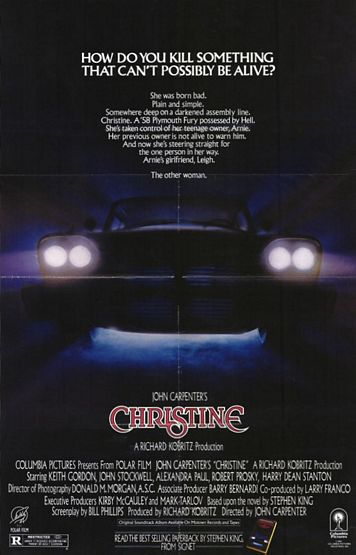
31 Days Of Horror: Day 8: Christine

(This not only acts as my last entry in Radiator Heaven’s John Carpenter Week, but my first entry in what will become my Stephen King Week. I love King. I’ve read and damn near own, everything he’s ever written.

But Good Lord his books have turned into some truly fuck awful movies. And I’ll be wading right in. Classic and disaster alike.)


Though it doesn’t often get credited as such, Christine is one of Stephen King’s most complex novels.

Just hear me out here for a second.

Yes I know we’re talking about Christine, the one where the car kills people. But King has a whole hell of a lot up his sleeve. He makes the novel a microcosm of adolescent experience dividing the novel into “Teenage Car Songs” “Teenage Love Songs” and “Teenage Death Songs”. Capturing how the years of impotency and repressed rage can fester and then erupt into fury (wink wink) which presages with startling precision the proto Columbine mindset even moreso then Carrie and Rage.

And while there is plenty to like about it, Carpenter’s adaptation doesn’t quite capture it.

Christine is one of those textbook problematic book to film adaptations. It irons out all the subtext, speeds up the slow burn, telescopes the action so things no longer develop but just happen, and basically removes all the interesting wrinkles from the book for the sake of expediency.

Still let’s face it, most aren’t watching Christine for it’s nuanced take on the adolescent psyche. Most are watching Christine to see a possessed hunk of unholy metal mow down "shitters".

But even this is surprisingly underwhelming. Aside from the suitably OTT finale; which features a bulldozer duel, and a sequence in which the Car drives around while on fire (something impossible not to make look badass and metal as hell) most of the crash sequences are strangely underwhelming. For a movie that features cars running into things the stalk sequences are surprisingly “low impact” (sorry I was possessed by the ghost of Peter Travers). Most of the time, people run screaming from the car, the car corners them, and we cut away. Death Proof this is not.

The cast does a decent job, particularly Keith Gordon, who does his best with Artie, even if the screenplay basically has him turn from guy getting sand kicked in his face to swaggering hood more or less off screen.

Christine as a movie just isn’t as tight as the typical Carpenter fair. It’s filled with odd stylistic tics. Like the true crime style date subtitles that occasionally pop up, and narrative dead ends. Like Harry Dean Stanton’s perfunctory role, as a detective who shows up to harass Arnie in a few scenes, disappears, and then randomly appears in the last scene to solemnly inform our two leads that they are heroes, having never once appeared in the same scene with them prior to this event. One keeps waiting for one of heroes to turn to him and ask "And who the hell are you?" Obviously his role was cut down, and I’m never particularly sorry to see Harry Dean Stanton. But it's weird sloppy details like that which keep Christine lodged firmly in Carpenter’s second tier.

Wednesday, September 29, 2010

Stuff I've Been Reading: September

Stuff Read:
Johnathon Strange And Mr. Norrell, Susanna Clarke
The Hilliker Curse, James Ellroy
Spook Country, William Gibson
Jimmy Corrigan, Chris Ware
Role Models, John Waters
Batman Gothic, Grant Morrison
Mockingjay, Suzanne Collins
Dead Zone, Stephen King
All Things Considered, GK Chesterton.


Jonathon Strange And Mr. Norrell is a thousand page novel that feels more like a massive intricate prologue then a novel in itself. Its pacing is, well let’s just be polite and say deliberate. And the lone protaginist for the first three hundred pages is an unpleasant old man who looks and acts like Mr. Burns at his most vulnerable.

But it’s still a pretty damn good read.

If Strange and Norrell was a shade more conventional, it would fall completely out of balance. In shirking every opportunity to embrace fantasy clichés, it excuses itself from having to pay lip service to a single one. By being eccentric in every aspect it excuses itself from having to play by any rule.

The thing that makes Johnathon Strange And Mr. Norrell magical (sorry I was momentarily possessed by Gene Shalit and could not resist) is that it doesn’t merely seem like a book about this era, but actually from it. Which is why it’s not only permissible, but commendable for the novel to spend oh say about 90% of it’s time doing nothing in particular but observe the nature of it’s characters, and the rules of their society.

The story follows the decades long struggle between two English Magicians, who bring “Practical” magic back to England after it has lain dormant for centuries. The consequences of this act are further reaching then either could imagine. Around them, Clarke weaves a tapestry of characters of Dickensian (or to be slightly more accurate Austenian) proportions. And supplements the book with countless annotations and footnotes, that make the world about them live and breath like few do.

Strange And Norrell is amazing because there’s just so little like it. While almost all of today’s fantasy fiction derives either from Tolkien, or at least Howard, Collin’s novel draws from something much more primal and darker. It seems like nothing so much as the world’s longest Grimm’s fairy tale. Powerful and mysterious, with undercurrents of something ancient.

It’s not for everyone. But the people who it is for are lucky.


Last Month I wrote a review of Catching Fire, that I now must partially recend. My complaints about the book’s style and structure still seem valid to me, indeed, maybe even more so. But one thing was clear. I was underestimating Suzanne Collins.

Vastly.

Mockingjay is one of those books that isn’t just an entry that is a success in and of itself, but makes everything that preceded it better. Abruptly dragging the moral universe of Black And White that Collin’s presented into staggering shades of grey. With a plot that’s just merciless.

In my review of Catching Fire, I noted that Collins honors the predecessor’s she draws from. Here she does better. She earns them.

I won’t go too far into Mockingjay as all that would accomplish is to make little sense to those who haven’t read the other two books, and spoil things that should not be for those how have.

Suffice to say it’s an unrelentingly bleak and rather perfect capstone to a young adult series with serious teeth and ambition.

It’s so good I think it might single handedly undo the damage Twilight has done to a generation of readers.


Man Grant Morrison sure does like Batman to fight The Devil.

To be fair Batman isn’t facing off against Old Scratch Himself (though he does make a cameo). But rather a damned soul who is pissed at some monsters.

Batman Gothic is a depressingly bland book from Morrison, who despite my misgivings about most of his work knows how to write a damn good Batman.

And yet from the man whose created a run as distinctive as the current one (which I’m a huge fan of) and Batman Arkham Asylum (which I’m really not). Batman Gothic just seems like the work of an average Neil Gaiman wannabe circa the pre Knightfall era.

It’s not bad per se, though the pacing is a bit draggy for a four issue book. It’s just that it lacks both the eccentricity and depth that characterizes Morrison’s work, and which I always respect even if I don’t enjoy.

I wouldn’t dissuade anyone from reading it, but it’s just kind of taking up space.


Then on the exact opposite side of the comics spectrum there’s Jimmy Corrigan The Smartest Kid On Earth. Called such because the title “Jimmy Corrigan The Most Depressing Thing You’ve Ever Laid Your Eyes Upon” was presumably already taken.

Similarly to The Corrections, I’m going to be kind of Brief, not because there’s too little to say, but because there is far too much to go through in the brief amount of space I’m allotting myself for this. Like The Corrections, Corrigan is a major work of Modern literature and demands to be unpacked all at once or not at all. Half assing it really isn't an option.

Suffice to say, it’s a deeply felt, deeply miserable work, about despair and mediocrity, passed down through the ages, along with the deep hurts and disapointments that are transferred from Father to Son.

It’s kind of beautiful.

Though I have a tough time giving an unqualified recommendation to a book that made me kind of just want to curl up and die (perhaps not helped by the fact that I chose The Shutter Island Version of “This Bitter Earth” on repeat as my reading soundtrack). But alas I must.

Read Jimmy Corrigan.

Just make sure that someone who loves you hides all your razorblades and sleeping pills first.


I’ve always referred (in admittedly questionable taste) to William Gibson as my abusive boyfriend. Because no matter how many times he hit me, I’d always give him another chance.

Well with Spook Country it seems like he’s actually reformed. I don’t know if it’s just the fact that listening to it on Audiobook, narrated by Robert Dean’s lucid voice, just gave shape to Gibson’s prose. Making the jargon that so often obfuscates his books actually seem like part of a plan of some sort. Playing down the density of his prose, and emphasizing Gibson’s knack for vivid metaphor, well drawn characters, and subtle wit. Or if he’s just finally written a book I like. Either way it’s nice not to be locked out of the club anymore.

Gibson has traded his knack for sharply detailed (too sharply detailed) futures, for a keener sense of the chaos of the present. He uses the concept of locative art (art virtually imposed on the real world only seeable to those who have the frequency) to explore how the realm of the digital has created a simultaneous parallel universe, as our own world fractures ever more into what Gibson terms “secret histories”.

The book follows Hollis Henry; Cult musician cum journalist hailing from the oddly specific Pixies stand in The Curfew. Milgrim, an unflappable pill addict whose addled, dry under reactions to the various dire circumstances he finds himself in, draw some of the book’s biggest laughs. And a Cuban Chinese member of “the world’s smallest crime family” as they vie for a mysterious shipping container, the key to which is held in the unstable mind of the facilitator of Locative Art.

It might sound overly complex, but unlike virtually everything else he’s written the plotting is smooth. Gliding seamlessly from one protagonist to the other. Leaving plenty of time for Gibson’s trademark digressions on the merging of technology and Philosphy.

Behind them all, to one degree or another, is Gibson’s great late period creation, Huebertos Bigend (an obvious Swift reference, of whose meaning I have no idea. He seems if anything vaguely Vonnegutian). The “Radically Agnostic” Belgium Bajillionaire, whose voracious curiosity, and non existent regard for the consequences there of. Seems to make him a personification of the digital era.

The book isn’t perfect, The third act collapses as Gibson’s Third Acts are want to do. But only a little. It’s really his own fault as the question “What’s in the box?” will always be more interesting then the answer.

But as a whole Spook Country is an intriguing step forward from Gibson. And I’m very happy to be forced to reassess my opinion of him.


John Water’s is a charming personality, a great filmmaker, and a surprisingly graceful writer (his early autobiography Shock Value, is a favorite of mine, even if he does deride it as glib in this volume). Role Model’s finds him at his best and worst.

At his best, when he gives an endearingly humbled interview to Johnny Mathis, describes his fans as “People who feel uncomfortable in their own minority” (raises hand) and muses about the shocked expressions that people have when they see him on Public Transportation. Assuming that Water’s tools around in his own Filthmobile (an image once articulated that will never leave me).

Unfortunately things start to drag a little at then end of the book. I love Water’s for his energy and inclusiveness, and have long considered his polite nature and delighted humbleness to be his secret weapons. All four elements are in short supply in the closing two chapters, where he is in turn petulant and self aggrandizing, in away that’s just plain unnecessary. Not to mention more genuinely distasteful then Divine getting raped by Lobsterella.

It’s not all Water’s fault, over three hundred pages is a long time to spend with any one personality, and I suspect that If I broke it up more I would have hated it less.

Still most of the essays are entertaining and droll in the best Water’s style. Who else would we have to ask the immortal question was Tennessee Williams crazy or high when he wrote his autobiography?

Water’s God love him, writes like he’s both.


And while we’re in the realm of “For Fan’s only.” I also read Chesterton’s All Things Considered. Things are a bit more thin on the ground here. Chesterton is upfront about it being a minor work, and it contains both essays dependant upon turn of the century English Political Figures that will merely be mystifying to the modern reader such as, “The Third Duke Of Trensick Is Acting Like The Fourth Viscount Of Norwick”. And those such as, “Women Voters. Why This Is Hilarious.” (Note approximations) That will seem merely offensive.

Still, a good half the essays are as good as anything he’s ever written, and for those new to the blog, that means they are very very good indeed.


Rounding out The For Fan’s Only Trilogy, is another work from a controversial author with a beloved cult following.

In The Hilliker Curse James Ellroy, The Demon Dog of American Fiction, momentarily stops examining the thugs and perverts who’ve written American History, to examine the biggest Thug and Pervert he knows. Himself.

This is well traveled ground for Ellroy, who has rehashed his mother’s murder and perverted past, not merely in his fiction but in various essays and memoirs. Luckily that’s exactly what Hilliker is about. The ways in which her death was both the catalyzing moment of his life, and something he has used, sometimes even exploited, to excuse every fuck up in it.

The difference between the prose style of say Killer On The Road, and Ellroy’s documentation of his own life, is negligible. And there are scenes, including one where he documents a two year long cancer obsessed nervous breakdown, that made me wonder, both in and of itself and in the way Ellroy chooses to depict it now, if he isn’t crazy. Like literally, not figuratively. It’s intense, self aggrandizing stuff. And if you hate Ellroy’s Beats on steroids and scotch prose style, The Hilliker Curse might seem a trip to your own personal hell.

But if you have some affection for the old demon dog, The Hilliker Curse is moving stuff. It’s as close to a look behind the curtain that we’ll ever get from Ellroy. Though that doomed LA persona never comes down completely. We may have heard these stories before, but not like this.


Capping things off I revisited The Dead Zone in preperation for my review of the same film.

The Dead Zone is a book that I will always have a huge amount of affection for, given that it was the first “adult” book I can remember reading. Picked up at the library on a fourth grade field trip when I snuck away from the children’s section, and having heard, that King wrote “scary stories” I made my way to his shelf and hastily trying to pick a book before the teachers noticed my absence I became transfixed by the image on the cover (there’s a saying there I know.) The sight of a man’s face cast deep in shadow, half of it blotted out by a monstrous wheel.

So fucking sold.

Dead Zone is still one of King’s best, and makes an ideal entry point as it contains all of his good points as a writer and virtually none of his bad ones.

I wrote more or less all one can say about The Zone in my previous review. So I’ll just reiterate that The Dead Zone is a showcase for King’s genius with both people and plot. Spinning with Johnny Smith one of his most fully likable and decent heroes, with Stillson one of his most believable monsters, and with their combination one of his most terrifying nightmares.

It’s simply a great piece of pulp fiction.

Friday, September 10, 2010

The Dead Zone


(Tony Danoub, over at Cinema Viewfinder has been hosting a David Cronenberg based Blogothon which is just about the pinnacle of the format. I submitted a piece on The Dead Zone, and was honored to be asked to be a part of it. Go there if you want some fine criticism.)


Conventional wisdom says that the pairing of David Cronenberg and Stephen King was an odd one. Never mind the fact that the two have never shown each other anything but mutual respect. People can’t seem to wrap their heads around it. After all in one corner there’s ole Uncle Stevie, this generation’s Rod Serling: slaughtering a massive forest every year to peddle his mainstream morality plays masked as horror yarns to an undemanding public; delivering a gentle “boo” with a chuckle. And on the other hand there’s Dave Depraved himself: a man whose mind seems to work like an anthropologist from the future; a man given to dropping phrases like, “the genetic imperative to protect one’s offspring is strong” in interviews in order to explain parental love; a man if whom he ever had a sentimental bone in his body dug it out with a scalpel and sautéed and ate it long ago, but not after first examining it under a microscope; a man whose films thrive on the transgressive. How could the combination of those two ever work? Most critics when writing about The Dead Zone dismiss it, like the work of a major league baseball player making a charity visit to the farm leagues.

As with much conventional wisdom, this is all ultimately bullshit.


But why? It's not as if King films don’t depend on the chemistry with the director. It's no accident that his best adaptations are, for the most part, delivered by capable journeymen like Rob Reiner and Frank Darabont, directors as skilled at handling big emotions as they are big set pieces. The closest precedent for a director of Cronenberg’s clinical temperament would be Stanley Kubrick’s take on The Shining, a movie which despite its sterling reputation I find almost completely uninvolving, a profoundly miscalculated adaptation on a very basic level. What chance could Cronenberg have?

First off, unlike Kubrick, there’s not as much difference between the two artists as one might think. King’s writing does have certain flaws, but a tendency to play it safe is not one of them. I’ve always believed that King’s crossover success can be better connected to his uncanny ability to write how people think (he is the master of the interior monologue) as opposed to any promise of safety. Far from being the sentimentalist he’s derided as, if King has proven one thing over and over again it is that he absolutely will go there. He will roast children alive. He’ll leave his heroes broken. He’ll tap dance on the grave of the world. A happy ending is not a right with King.

But beyond their similarities in style, the fact is that King and Cronenberg walk the same beat. Roughly speaking, King’s horror comes from three areas of unease (as he calls sources of horror in Danse Macabre): the corruption of the mind (The Shining, Carrie, Cell, The Dark Half); the corruption of the body (Salem’s Lot, Misery); and the corruption of the soul (Pet Sematary, Desperation, Needful Things). These are the exact three areas from which Cronenberg draws his sources of horror from (though the stringently Darwinist Cronenberg would probably prefer replacing the term "soul" with "mind").

He is most famous for the corruption of the body, certainly inventing and more or less dominating the genre of body horror despite not making a movie that could be termed such for over a decade. And it is of little wonder. No one who has ever seen “The Museum of Brundlefly,” or the birthing of the children of rage, or whatever it is that happens to James Woods in Videodrome has ever forgotten the images. But the more I think about it, the more I confess that I believe the body horror in Cronenberg to be an elaborate feint, a window dressing for his real obsession, that of the corruption of the mind.

I’ll admit I didn’t start thinking that way until I began writing this very piece and tried to pinpoint exactly were Cronenberg’s shift from the horror of the body to the horror of the mind began. His last two films dealt with two personalities housed in a single mind. But surely it began with Spider. His portrait of madness that concerned itself solely with the disintegration of a single mind. But wait, before that was eXistenZ and for all the teeth guns wasn’t that primarily about the power of the mind over the flesh, the power of the mind to imprison the body in layers upon layers of intractable information? Crash and M. Butterfly are so obviously concerned with mental aberration it hardly even seems worth mentioning. Naked Lunch is life through the filter of Burroughs, which has to be damn close to a dictionary definition of mental mutation. Dead Ringers is in a way the reverse of his later films, a single personality in two physical bodies. The Fly draws as much horror from Brundle’s mental deterioration as from his physical deterioration, as does Videodrome. Scanners is about physical aberration brought on by mental aberration, as is The Brood. Rabid focuses on Marilyn Chambers' Brundlefly-like deterioration, and They Came From Within is, as King himself quipped, “as much about Erica Jong’s ‘zipless fuck’ as it is about how you’d like to have a leech affix itself to your face.” There’s literally not a case where Cronenberg’s terror of the body takes precedent over his terror of the mind.

The Dead Zone is King’s synthesis of these areas of unease. It gapes in horror at both the untold depths of the mind, and the havoc they can wreck on the physical body. Far from being the unlikely fit that it first appeared as, it becomes impossible to see how The Dead Zone wouldn’t be fertile ground for Cronenberg.

The Dead Zone follows Johnny Smith, a high school teacher who awakens from a coma to find he now has psychic powers. After several misadventures (and it is to Cronenberg’s credit that the film never feels episodic even though it intrinsically is), he comes across the man who seems destined to start World War III.

Smith is played by Christopher Walken. It takes awhile to readjust our expectations of Walken back to versatile character actor, rather then entertaining caricature. Particularly as we’re first introduced to him reading "The Raven" in the same deadpan sing song cadence with which he so memorably immortalized Goodnight Moon on The Simpsons and the lyrics to "Poker Face" on German TV. But readjust we do, because Walken makes Smith a character of such apparent decency, though his weird charisma and pools of rage keep him from being the upright mannequin he easily could have been in the hands of a less idiosyncratic actor. Decency is a characteristic Walken is not often called on to display (a notable exception being Catch Me If You Can... perhaps not coincidently one of the few times in the past decade he’s played a recognizable human being), but he does so admirably.

The film does have some flaws, but they are the usual flaws of adaptation. Cronenberg cuts the book’s prologue and initial psychic incident, making the reveal of Smith’s talent considerably more abrupt. This is more problematic for the Stillson portions of the film, as it means the main antagonist doesn’t appear until a full two-thirds into the movie. Instead of hanging over the proceedings as a portent of doom for its entirety, Stillson shows up, announces, “Whelp, I’m crazy, and here to set the third act in motion.” It’s a shame because Sheen nails the character, giving the character a neocon swagger twenty years ahead of schedule; a shame because in the era of Glenn Beck and Sarah Palin, Stillson seems down right appealing. I mean sure, he wants to start a nuclear holocaust and uses a child as a human shield. But he can form a sentence that isn’t a hate crime against syntax, and that has got to count for something.

The action seems a bit telescoped, with every psychic event occurring right after the other, allowing none of the dread of waiting for the other shoe to drop that King builds into his novel. This is not entirely the film's fault as long scenes of existential dread do not fit readily into mainstream horror films, particularly those produced by Dino DeLaurentis. That said, the scenes themselves are so good that it becomes easy to get lost in them, no matter their arrangement. From the opening shot, The Dead Zone is a movie entirely in control of its tone. It’s interesting to note how clearly the opening scenes would echo A History Of Violence, images of American wholesomeness undercut by Howard Shore’s eerie score, the Cronenbergian void literally cutting transgression out of the peaceful landscape in what has to be one of the creepiest opening credits of all time. The trances are shot in the most straightforward way imaginable for psychic trances. Cronenberg treats them like reality, so they become reality, which isn’t to say that Cronenberg’s talent for arresting imagery goes unused. I for one haven’t been able to shake the scene of the boiling fishbowl erupting since seeing it.


The murder in the gazebo shows Cronenberg working in a key I’ve never seen him shoot in before and is, for my money, one of the most underrated suspense scenes of all time.


So much open space, so much light, we can see so far. Surely someone must see them. Surely someone must stop them. And in a cruel bit of trickery, we know the answer already.


There’s Dodd, now dressed almost exactly as Walken simultaneously foreshadowing and perverting Walken’s act of sacrifice.


The Dead Zone is as meticulous a film as Cronenberg has ever made. But unlike The Shining, where the meticulous itself was the end game, The Dead Zone serves the story it tells. The two artists who told it do not clash but synthesize, an action most familiar to viewers of Cronenberg.

(Don't ask me about the weird ass formatting issues. Ask Blogger)