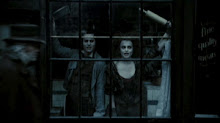
Saturday, November 6, 2010

The Unseen #49: The Trip


Why’d I Buy It?: Came in the Roger Corman Boxset I Purchased (Last One Of These!)

Why Haven’t I Watched It?: Indifference.

How Was It?: There is a problem inherent in making any movie about psychedelic. As anyone who has ever dabbled in it even the slightest bit knows, any hallucinations in the Beatles sense of the word is completely secondary to the profound shift in perception that occurs in the user.

(Not entirely accurate)

In other words what’s remarkable isn’t so much that you would meet a clown with the face of a fish who speaks in the voice of your dead auntie. Its that this would not surprise you at all. But it's not even really about that either, its about the sense of connectedness, seeing behind the makings of things however temporarily. A sense of profundity. However fleeting it ultimately silly it may feel in the harsh light of sobriety.

So basically no matter how many fish eyed lens, vibrant colors, quick zoom ins and zoom outs, or how much you shoot in Widescreen without anamorphically adjusting the image you’re never going to capture that intangible feeling. Which is why so many of the most famous psychedelic movies, Fantasia, 2001, The Fountain, have absolutely nothing to do with Psychedelia.

Instead, you’re going to just waste your time and effort looking really really silly.

Which is as you may have guessed exactly what happens in The Trip.

The kind of movie were people do things like were Nehru Jackets and speak lines like “Hey don’t bogart that joint!” whilst wearing them, all without even the slightest whiff of irony..

Peter Fonda plays a young executive suffering from malaise (were there any other kind in the sixties). He procures some acid from Dennis Hopper (always a dicey proposition at best) and with Bruce Dern as his spiritual guide (once again, always a dicey proposition at best) he wanders out into the night on the Sunset Strip. A Place where young nude painted dancers gyrate wildly to music provided by a band called Electric Flag. Brightly colored strobe lights flicker and everything is always canting CANTING CANTING!!! He also wanders in and out of random peoples homes. Giving long winded musings about commercialism, sex and women’s lib. Some are so pleased to find Peter Fonda stoned out of his ever loving gobstobber has deigned to stumble into their home and drop his science that they have no choice but to have sex with him. I have a feeling he would have less success if he tried this now.

Also Bruce Dern pulls him naked from a pool.

It all culminates in the hallucinogenic “Trip” of the title. In which Dennis Hopper wearing purple velvet menaces Fonda as he rides a carousel (Man I’ve been there) and then Fonda looks at pictures of Che Guevera, Sophia Loren, and Khalil Gibran (one of those things is not like the other) with mounting horror until he screams “BAY OF PIGS!!!”

It’s all profoundly inexplicable.

As you might have surmised The Trip is a pretty big turkey. But I think its almost impossible not to have fun with. It’s goofy as you can get, and calling it a time capsule does damage to the right honorable and venerable tradition of Time Capsules.

But every once in awhile it is nice to remember that for however briefly there was a time when Nehru Jackets and a band called Electric Flag were both the very height of cool.

Because Seriously Fuck Lebron James


Asshole.

Thursday, November 4, 2010

Politics And Other Shit No One Wants To Hear About

(Note: I am aware that this is not a political site. And you as a reader probably have next to no interest in my feelings on the recent election. To which I sincerely invite you to return to the site tomorrow when the regularly scheduled program of trivial bullshit will have resumed. What can I say though? Some days you just can’t fake it.)


Gratifying as it was to watch the conservative take over of America stop dead at the Sierra Nevada’s. This came at the expense of having to watch the American people once again prove that they have the memory of fucking Goldfish.

Brightside though they were the defeats of Fiorini, Whitman and Prop 23 only sent the message the American people (Or at least Californians) will not accept plutocracy only when it comes up, smiles and blatantly announces itself as such.

Small comfort though this may be. This is less encouraging because Plutocracy very rarely do this. It's much more apt to sit smile and cloak themselves in “populist” rage.

But here’s the thing, as much as I can bitch and moan about the disgusting propaganda and misinformation, the Right of this country employed in this election, the gullibility of the electorate, and the stupor inducing insanity that is the Tea Party Movement (You know that Rand Paul and his cronies are asking for a 27% sales tax right? Just checking).

Despite all of that I can’t really argue that the Democrats got anything but what they fucking deserved.

Sure we can point to the forces beyond the party’s control. The economy they inherited in ruins, the two endless wars left as a parting gift. But by extending the Bush II’s policies on the war, the bailouts, redaction, Don’t Ask Don’t Tell, failing to close Guantanamo Bay, giving up on the public option. Selling out on the promises they made they lost the support they took for granted.

Let’s face it The Bush administration was such a travesty that after eight years of it you could have politically mobilized a crew of corpses.

But the Democrats spent the term infghting and squabbling. All too cowed by the vocal minority (literally at those God awful Healthcare “Town Halls”). Fractioning both their blocks of power and their support. Making concessions for vague craven hopes of political survival.

You want us to mobilize for that?

I mean really, to the powers that be, had the Democrats, stuck to their principles, had they stood as a whole and used their majority in the ruthless way they Right uses theirs, how much worse could it have gone? What could you have lost? Instead you have a Congress so bumblingly fucking broken that they couldn’t even force through easy wins like emergency Health Care for first responders to 9/11.

To the Democrats I can only say, if you stick to you’re principles, we will come out and we will support you. We’ve done it before and we’ll do it again.

Realistically all that has been lost is half of a third of one of the branches of government. Not what you would call a death blow.

But continue to offer disorganized squabbling as opposed to genuine opposition? Well I don’t need to tell you what will happen. You just watched it.

Wednesday, November 3, 2010

Sugar Hill

(This review has been re educated to make glorious benefit for Supreme Overlord Stacie Ponder. Ruler of Final Girlandia. Maker of most righteous Ludlow. All Hail President Kang Ponder.)


Sugar Hill opens with a frenzied, dynamically edited Voodoo Dance. And just as my brain is cross checking references, comparing it to the voodoo scenes in I Walked With A Zombie and Angel Heart, the camera pulls back and reveals the whole thing to be a put on. A sham, designed to entertain the mostly white patrons of “Club Haiti”.

Welcome to Sugar Hill a movie that is continuously smarter then it needs to be.

The film soon moves into boilerplate blaxsploitation. As the owner of the club is murdered by Mafiosos and his girlfriend swears revenge. Like I said, all standard Blaxsploitation stuff, along with outlandish fashions, a wakka chucka heavy score and ties so large they have their own gravitational pull.

However, to get her revenge she gets goes to her old neighborhood priestess to help her contact Baron Samedi, who raises an army of undead slaves for her, in exchange for her soul.

It is here that the film begins to decidedly diverge from the standard Blaxploitation movie formula.

The encounter with Baron Samedi, and his subsequent raising of the army of the irate dead is genuinely eerie in its matter of factness. The zombies themselves are legitimately creepy, draped in cobwebs, with Ball Bearing Eyes and eager grins, going about the evil deeds of their mistress with enthusiastic relish (And this is despite the fact that they bear an uncanny resemblance to the rasta aliens in Buckaroo Bonzai). That being said, in one of the film’s few major missteps they inexplicably decide to forego The Baron’s uber iconic appearance. ( In all other regards the actor does a fine job. And it's always interesting to see an actor rip into a role when they were given few other chances to do to just that. Given that Don Pedro Colley's other major roles were "Waiter With A Cake" in Herbie Rides Again, "Negro" in Beneath The Planet Of The Apes, and a reoccuring role in the back half of The Dukes Of Hazard I think it's safe to say that he never got to play on quite the same level of joyful malevolence.But imagine a film featuring an encounter with a clean shaven short haired Jesus.)

(Baron Samedi)

(A black guy in a top hat)


Unfortunately the actress potrarying Sugar is free of the burden charisma or acting skills, the actor who plays Detective Valentine, her foil, love interest, and provider of powerful filler, is if anything worse, laughably wooden. Like Ed Wood lead wooden. Together they leave a large and rather noticeable hole at the center of Sugar Hill. Though perhaps this is all for the best, had say Pam Grier and Robert Roundtree starred in the film it would have obliterated all need for any other film to ever be made.

Still, Sugar Hill does so much right that it is easy to forgive the things it does wrong. Particularly with the sliding scale that one usually judges exploitation movies. While carefully maintaining the balance of between the contradictory tones of fear in a horror film, and the cathartic nature of a revenge film. Sugar Hill is one of those rare films that manages to have its cake and eat it too. Right down to the way it completely lets it heroine off the hook, despite all the signals it sends that suggest otherwise.

I’ve wanted to see Sugar Hill since its bat shit insane trailer showed up on 42nd Street Forever Volume 2. That trailer made the movie look impossibly fun. But the fact is that most exploitation movies only live up to a mere whiff of their potential.

Sugar Hill belongs to a rarified sub genre. That of the exploitation film that is exactly as much fun as the trailers and posters make it look.

Tuesday, November 2, 2010

Some Thoughts On Two Images


Look I’m not sure what the reaction that Spielberg and Jackson were going for when they released the first Tintin image, but if it was “Oh God Kill It With Fire!!!” well then they straight up nailed it.

It’s like they were aiming for the uncanny valley and hit it smack dab in the middle at its deepest point.

I literally don’t know what to say about this image. When I first heard about Tin Tin I was excited because the clean line style of Herge perfectly sidesteps the problems that Mo-Cap presents. How two guys as smart as Steven Spielberg and Peter Jackson could look at this:

And think this:

Is literally beyond me.

This image on the other hand makes me very excited:

It’s been a bad year to be a Kevin Smith fan. He spent 2010 burning through an awful lot of good will. Leaving even a dedicated apologist as myself feeling a very real sense of fatigue. It wasn’t so much Cop Out (or The Widening Gyre because Jesus Christ that thing…), I’ve forgiven bad Kevin Smith movies before and I’m sure I’ll forgive them again.

No. It was the reaction to Cop Out, in who's aftermath he gave a series of increasingly defensive vindictive interviews that eventually spiraled into out and out paranoia. With Smith trashing his work, his fans, and particularly those who ever had the gall to take his work seriously. It was like watching a friend so drunk at a party that he's totally unaware his dick hanging out of his pants as he's talking to a woman who dumped him six months ago, alternating between sobbing and incoherent threats. Smith embarrassed himself and it was ugly. There’s no other way to put it.

Which is a damn shame because I LIKE Kevin Smith. Still do. I know it’s not cool to say, but damn it Clerks still works. Chasing Amy may not be perfect, but it’s heartfelt, honest, and genuinely funny. Not to mention both a perfect time capsule of both itself and a certain kind of 90’s filmmaking. And damn it, it deserves it’s Criterion. Dogma is my favorite movie about Faith not called The Last Temptation Of Christ. Yes I’m serious. Frankly it’s not a movie for non Catholics, there I said it, but as a portrait of a smart ass coming to terms with his faith, I find it both moving and funny. Zack And Miri is good for a chuckle and Clerks II is a great film.

Yes you read that last part right.

So yeah, I like Smith. And watching his demo derby this year stung.

But I knew he had his ace in the hole. A film I’ve been wanting to see since it was announced pre Zack And Miri. A film Frankly I kind of thought I’d never see at this point.

Well here it is, and if the finished film has a quarter of the atmosphere, dread, and balls that that image says it does, if it’s the dark night of the soul to Dogma’s sunny affirmation, then I’m going to be a very happy man come 2011.

Fans of Smith may recall that following the disaster that was Mallrats Smith licked his wounds, went back to his roots and made Chasing Amy for a quarter of a million dollars. Red State cost four million, basically the equivalent of a quarter million Clinton dollars anyway. Here’s hoping he does it again. Takes step back reconnect with what made him great, and make an honest movie.

Come on Kev. I’m rooting for you.

The Walking Dead


George Romero defined the zombie film. And in that he perhaps did his job too well.

Very few zombie movies, hell zombie works in any medium, have pushed past Romero’s films, either narratively, stylistically, or thematically. The greatest deviation from the text thus far being the staggering idea, “Well what if the zombies… were like… fast?”

Virtually all Zombie movies end at the same point, with the last vestiges of civilization crumbling and our remaining heroes (if any there be) running off into the wilderness. (Two major exceptions being Danny Boyle’s nominally happy ending to 28 Days Later. Which along with Shaun Of The Dead tell me that though Brits might be cynical about a lot things, their trust in their government's ability to handle an outbreak of zombies is absolute). And Romero’s own criminally underrated Land Of The Dead. Some would argue that Dawn Of the Dead qualifies, but the mall is so insular I don’t think it counts. Had the film followed the bikers, then sure.) Were they go from there and what happens next has not been a question filmmakers have been particularly interested in asking.

Even movies like 28 Weeks Later which pointedly take place in the aftermath of a zombie disaster seem more or less dedicated to taking things to square one.

In the word’s of Henry Jones Sr. “They leave just as they’re getting interesting.”

There is of course one major exception to this rule, which would be Robert Kirkman’s The Walking Dead. The secret to Kirkman’s Zombie opus, now Frank Darabont’s as well, is that it’s not really about Zombies at all. Though it makes fantastic use of them they’re really just one hell of a macguffin. The book could be about anything that forces society to rebuild itself. One suspects that Kirkman could have written his book about the aftermath of a plague, or a war, or an alien invasion. It’s all about the interruption of societies continuity. And what happens afterwards.

Or as Kirkman himself so succinctly put it on the back of each Walking Dead trade.

“When is the last time any of us really worked to get something we wanted?

How Long as it been since any of us really Needed something that we wanted?

The world we knew is gone. The world of commerce and frivolous necessisty has been replaced by a world of survival and responsibility. In a matter of months society has crumbled. No government. No grocery stores. No mail. No cable TV. In a rule ruled by the dead we are forced to finally start living.”


That last line may be a bit on the nose. But there is simply no escaping the fact that Kirkman’s underlying message is that mankind would be much better off with a 99% of it’s trivial bullshit mercilessly and completely swept away.

And he makes a compelling case, despite the parade of horrors he’s shown.

Romero, who always tied his ghouls into specific aspects of social satire (Racism, Consumerism, Militarism, Neo Cons, Social Media Solipsism, the er Irish?) never came as close to obliterating the system in it’s totality.

This is in all fairness at least partially due to the fact that Romero had to tell his story in two hour chunks, while Kirkman has the luxury of at this point literally thousands and thousands of pages.

I’m certainly, not meaning to dig at Romero, who I admire immensely as a filmmaker, and not just because of his zombie pictures. And I certainly don’t think that Kirkman ever would have made Dead without Romero. All I’m saying is, that Kirkman, unlike just about every other person who has tackled the zombie in the past forty years, took the baton that Romero was waving and actually ran forward with it.

And if you haven’t experienced it yet, either in it's original form, or the Show which premiered on TCM last night. then brother you’re cheating no one but yourself.


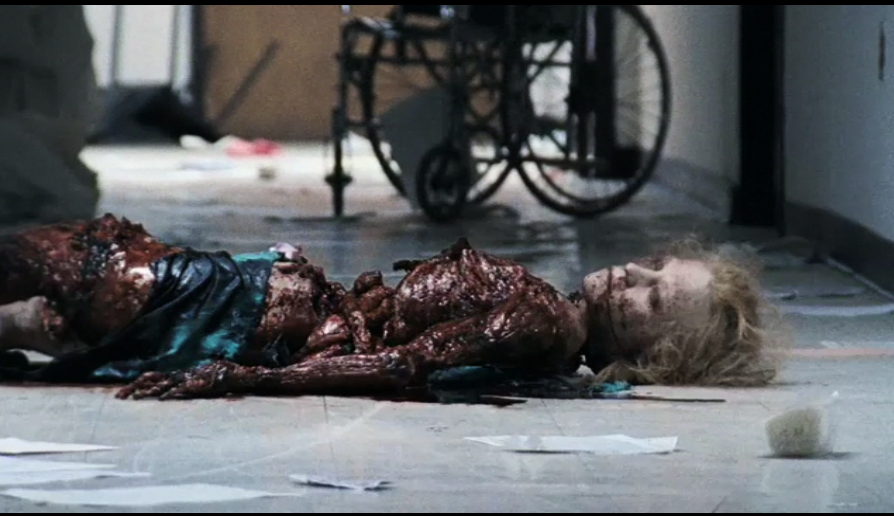
The show begins, with a scene not in the book. With Rick our hero, wandering through the ruins of modern society, into what was apparently an attempt to set up a camp similar to our heroes. It’s that second tier that really makes it haunting. First one thing fails, then the response to it does. Then after a brilliant tease Rick is forced to shoot a little girl in the face. It should become clear at this point that “Fucking around.” is not on Frank Darabont’s list of things to do.

And indeed in no aspect of the production does Darabont fuck around. Everything from the naturalistic dialogue, to the genuine epic sweep of the visuals.


To the gore (mostly practical thank God). Indeed the gore made even me raise my eyebrows. Quick anecdote; a few weeks ago I was hanging out with at a friend's and we happened to watch Friday The 13th Part 3 on AMC, but quickly changed the channel, when it became clear that AMC was cutting out all of the gore gags. After watching Grimes literally stumble on a woman whose midsection is nothing but some vaguely recognizable lungs and intenstines, I can’t imagine why. This stuff would give Tom Savini nightmares.


(Zombies apparently don't fear the FCC)

Right now one of the big discussions going on, is the fact that TV is doing movies job. Jim Emerson has been a big proponent of this, and like with most of what Emerson writes I disagree.

TV is a serialized medium, and Movie's are for the most part not.

A long running film series, like say just for a point of example, Sam Raimi's Spiderman, is lucky to last 3 movies. Break it down, that movie tells "a story" over about seven hours, and five years.

Compare that to the average Television show that last five years. That show if you break it down to forty minutes an episode, twenty two episodes a year is going to have seventy three hours to tell its story. 


Now that is both a blessing and a curse, as even the greatest TV show is going to have some weak points (Anyone remember the "Cast Of The Sopranos argues with Indians about Columbus Day" episode?)

The grey area, it seems to me, comes on DVD. To take The Sopranos as the example again, there is no way you can tell me that David Chase didn't look at the extended multi episode dream sequence that opened Season 6 and say "Eh, It'll work on DVD." 

That's where I first saw it, and I think it worked pretty damn well, but people to this day still bitch about it because they saw it over the course of three weeks rather then three hours. 

My point is, there may not be a huge amount of difference in how TV and Film is made. But there is a HUGE amount of difference in how they are processed.

That being said, if anyone is taking advantage of the new found porousness between the mediums it’s Frank Darabont. Able to transfer his Television crew from The Shield to shoot the down and dirty The Mist and able to effortlessly give The Walking Dead a sense of cinematic grandeur. Right down to the Drew Struzan poster.

(C'mon, that's fucking cool)

Darabont makes plenty of smart moves in the adaptation. He’s able to take concepts Kirkman didn’t think about until later (such as the consequences of Gun Fire) and introduces them as the rules of the world from Day 1. At first I have to admit I was a bit worried that the first arc of Walking Dead would be too slim to sustain a season of television. After all Kirkman tells the story in just one hundred and forty pages. But comic books are tricky, it’s not enough to tell a story in the thousands of pages a long running series can get, you have to be able to tell a story every twenty four pages as well. What Darabont does is expand the story without really adding any extraneous filler material. Where Kirkman had to be ruthlessly concise Darabont can stretch out a little. Taking scenes like Rick’s escape from the hospital, characters like the man who saves Rick, and relationships like Rick’s with Shane, all almost throwaways in the book, and expands and deepens them. It’s like being able to glance at what happens just before and after the various panels. The Walking Dead stands as an example of adaptation that is damn near perfect.

I may not agree that Television is supplanting movies. But I will gladly agree that The Walking Dead is scary, better made, and more human then any of the pathetic offering we horror fans got this October.

If the show remains this good, and its source material has laid down an excellent road map to it doing just that (provided that they keep the prison to just one season) I think we’re looking at a serious classic of the genre.

Monday, November 1, 2010

Stuff I've Been Reading October


“Tessa’s feet were screaming in her fasionable boots.”

This sentence, dropped in the middle of a chase scene involving dozens of vicious automatons, apropos to nothing, should let you know all you need to about Cassandra Claire’s immense deficiency as a writer.

In my line of work it behooves me to keep abreast of at least a few YA titles. So when I came across Clockwork Angel, I realized “Hey I like both Victorian London and Eternal Battles against the Darkness! How bad can this be?” Hoo boy.

The blending of Victorian and Occult fiction is a natural one. Both depend upon the thrill of the hidden society concealed within the world. Wheels within wheels powered by arcane codes of conduct.

Anyway the story is the usual mumbo jumbo of a young girl caught in between the forces of darkness represented by blah blah blah. The point is she soon ends up predictably caught between two life support systems for abs and we go on from there.

All the usual flaws are here, characters who range from vapid to merely dim. A plot we’re several steps ahead of at all times. Writing that’s declaritive and dull (It doesn’t help that Claire makes the decision to start each chapter with some of the finest lines of Victorian verse. Reminding our poor brains what good writing does look like) and Banter that is jarringly contemporary.

But here’s the real bad news. There are scenes here, isolated though they may be. That actually suggest Claire could become a good writer. A scene where our young heroine stumbles into an abattoir where the corpses of the innocent are being fused with machines, are written with a vividness that suggests a dark and fertile imagination that Meyer’s and most of her ilk never had.

Should Claire ever shrug off her bad habits it’s possible she could become a hell of a writer.

As she has already been amply rewarded for those bad habits, that seems rather unlikely.


I have begun a delightfully unexpected late in life love affair with Ray Bradbury.

When I was the age when most discover Bradbury his indirect florid prose frustrated me. And to a certain extent, say in something like "Jack In The Box", it still does. But setting aside his stylistic ticks Bradbury is one of those treasured authors who marches in no one’s territory but his own.

Most of the stories in October Country aren’t quite horror, fantasy or sci fi, though some like The Small Assassin would fit quite comfortably. Most just hum along on a kind of all American wrongness. A feeling like you’re conversing with Will Rogers after ingesting a few tabs of acid.

The Halloween Tree exists on the same inimitable plane. It’s hard to imagine a children’s book with scenes as intense as the children’s encounters with Samhain and it’s grisly aftermath being released today. At least not without the school board getting buried in letters. But The Halloween Tree maintains a feeling of good natured malice, if not comprehensibility.


Yeah I’m pretty sure I dug this one.


Squirrel Seeks Chipmunk finds David Sedaris in an unusually vindictive mood. Though there are few writers better at ripping apart people behaving badly, Sedaris more vicious tendencies are usually countermanded by his inherent amusement and affection for people.

He apparently feels no such need when faced with animal characters, and most of his stories quickly fall into levels of bad behavior and misanthropy which are Ellisian. Things pick up a little at the end, when Sedaris lets up on his targets just a little. And his prose is witty and graceful as ever. But it can’t help but all feel more then a little pointless.

I was lucky enough to attend a reading of Sedaris earlier in the week, where he read a few stories. And as expected they worked much better (though unexpectedly, despite what his persona may have you believe Sedaris is borderline gregarious in person. He also drew an owl in my copy of Me Talk Pretty One Day. I have no idea of its meaning and it haunts me) Sedaris reading of his own material has always been as much a key to his success as his prose itself, if not more so. And Squirrel is no exception, in this regard. But perhaps it is an exception as it is the first of his works that cannot stand without it.


Bill Bryson an author of boundless curiosity, humane temperment, lucid civilized prose and a lacerating dry wit is one of the most purely pleasurable authors I know of. A Walk In The Woods is of course, no exception, and arguably his masterwork.

The saga of Bryson’s attempt to walk The Appalachian Trail, A Walk In The Woods is hilarious and unsentimental, and yet full of wonder. Accompanied by his obese fouled tempered Sancho Panza, Katz Bryson chronicles his attempt to hike the AT, intercutting it with musings on the trails history, the disastrous ecological state of America, bemused vignettes on the short comings of other hikers, a fear of bears to rival Stephen Colbert's and whatever else enters his mind.

It’s a worthwhile trip as it always is with Bryson, even if he grows a little defensive at the end. But for anyone who has yet to walk with him, this makes for a perfect introduction.


But in all these tales the dog is the innocent shoot star/
We all wish upon/
Until It burns up, aging fast and disappearing/
Beyond our jagged horizen

I already covered these in my five horror books column. I’ll just note that beyond all it’s affectation Sharp Teeth is a truly human horror story. And even if the master plot never really holds together as much as it seems it is going to, watching it get there is still a thing of beauty.

John Dies At The End is a tough book to review. Since so much of it’s pleasures come from it’s unpredictability. It’s rare when one of its 375 pages does not contain a turn on a dime plot twist, hilarious joke, or truly horrifying concept.

I regret even to inform you that there is a cock punching demon named Shitload (One of the books cleverest jokes. Think about it for a second.) Feeling vaguely like I’m robbing you of something. So if talking about what I like about the book spoils it, and talking about my very minor quibbles, like the fact that it’s really more of two or three novellas stitched together then a cohesive novel, make me feel grinch like, what does that leave me with to talk about?

Well how about this. Buy it! Buy it Now!


I’ll admit I did not have high hopes for American Vampire. I have an aversion to co-authored work And it seemed at first glance to be yet another toss off in a year of toss offs for King. Which he’s used to clear the pipes after Under The Dome.

So it as suprising and thoroughly gratifying to learn that I had thoroughly underestimated American Vampire.

It’s a stylish, funny, badass, dark, substantial, and yes scary reworking of the vampire mythos.

King sums the mission statement up perfectly in his introduction.

“Here’s what Vampires shouldn’t be: pallid detectives who drink Bloody Marys and only work at Night, lovelorn southern gentlemen, anorexic teenage girls, and boy toys with dewy eyes.

What should they be?

Killers. Stone Killers who never get enough of that tasty type A.


At the heart of American Vampire lies a surpringly potent metaphor. The title is not accidental. The story follows as the increasingly decrepit and outmoded European Vampires fall in the wake of WWI as the titular American Vampire Skinner Sweet (Who puts the anti in hero then goes ahead and throws away the hero part) rises. His vitality inextricable from his viciousness.

If there is a flaw in the book its that the parellel stories really are parellel stories. Never quite meeting despite the final stinger.

They’re both fine they just plain don’t touch on each other. In the intro King writes that he requested to write Skinner’s origin. And given how the book is structured it’s hard to believe that Scott Synder wouldn’t have waited to reveal Skinner’s origins for a later issue, or perhaps even a miniseries. And for those annoyed by them, be aware that King’s idiosyncrasies as a writer are in full affect. Only King would introduce his full formed Vampire lead by having him burst out of his watery grave, like a pissed off jack in the box with the line “HELLO MOTHER FUCKER GOT ANY CANDY?”

Still I found American Vampire the perfect way to wrap up the holiday season.