(This is my entry in The Self Styled Siren and Ferdy On Film's Love Of Film Noir Blogothon. This is a celebration of Film Noir but it's also a fundraiser working to save and preserve the film The Sound Of Fury. I've made my donation and I hope you will too. Remember every little bit helps.
And if you like Blogothoning I hope to see you back here at The Sam Raimi Blogothon Things That Don't Suck will be running between March 27th and April 2nd. There's no worthy cause except the celebration of a great filmmaker. But it should be a lot of fun anyway. And contributions are welcome.)
Kiss Me Deadly is one of the finest film noirs of all time, arguably the last great noir of the classic era. It ends with one of the most justly famous endings of all time (incidentally this is the first closing I've covered for Scenes). The film was directed by Robert Aldrich, the man responsible for some of the most macho films of all time as well as some of the first self aware kitsch. Aside from The Big Knife starring Jack Palance, which is closer to a really pissed off The Bad And The Beautiful then a traditional noir, Kiss Me Deadly is the only Noir Aldrich directed.
It's probably the best film of Aldrich's career (though I might have to slot Vera Cruz one of the most preposterously entertaining films of all time in front of it). Dealing with the search for a mysterious box, whose contents are never clear. Until the end... (Consider this your Spoiler Warning)
The scene begins where most film noir’s end, with the femme fatale shooting both the big bad (Dying as he lived. Pedantically.) As well as our anti hero Mike Hammer before finally taking possession of the box.


Gaby Rodgers plays the role with a kind of madness. Unlike most Femme Fatale's she's never portrayed as any kind of sexual dynamo, Hammer shows the least interest in her out of any of the female cast. She just sits there, a quiet and unassuming wallflower, until you suddenly realize there is psychosis in her eyes.

That madness brings Meeker's Hammer up short for the first time in the film. Mike Hammer isn't much of a detective. He is more or less a simple goon. In many ways he is the Anti Phillip Marlowe. Marlowe is a tarnished white knight, the one "who is not mean". Hammer a "cheap sleazy bedroom dick." Marlowe gets information beaten into him. Hammer beats it out of people. He's such a dominate force, even when he's out cold, tied to a bed and drugged that when he's finally genuinely caught off his guard it's a real surprise.


Hammer is instantly diminished, shoved into the smallest corner of the frame. He will never again regain the dominate position in the frame that has been automatic since scene one. It's as if he's almost shrinking in anticipation of the brave new world that Gabrielle is about to release. Doesn't matter how tough you are, you can't muscle atomic energy.


There's a grace and solemnity to the way that Gabrielle opens the box. Despite her supposed motivation of greed her's is not the manner of a cackling woman triumphantly about to enjoy her loot. It's an act that is almost reverent.


This is one smooth invisible edit. The final warning received...

And disregarded...


Once again, the way Aldrich elevates her reaction. He consciencely told the story of Lot's Wife and Pandora's Box before this moment and he clearly means for this moment to rank with them. It's not mere fear that Gabrielle experiences, that's the last emotion to hit her. It's nothing short of awe.

Coupled with the light and the wisps of smoke, the whispering of the box and the malevolent nigh Satanic intelligence it suggests is one of the most effective sound effects I know of.


Soon overlaid with Gabrielle's screams.

Kiss Me Deadly is perhaps the most frankly violent Noir this side of The Big Heat. Though the obvious superimposition is an odd effect, but the surreal nature of the effect makes it even more unsettling.


This odd strobing effect continues throughout the sequence. It is an odd touch, mostly because there is no source for it, being one of the few things that Aldrich does purely for style in the film. Throughout the movie Aldrich eschews the more expressionistic elements of Noir, preferring to let the atmosphere of fifties LA speak for itself. Yet there is no objective basis for the strobe. Every time we see the light it's steady. Yet the stronger the light gets the darker it becomes. It’s as if the device has suspended the rules of reality that Aldrich has worked so hard to preserve.


The fact that the burning (and still screaming) Gabrielle is clearly a dummy does nothing to make the shot less disturbing. If anything it heightens the eeriness of it. Calling to mind the infamous footage of the nuclear tests in the fifties. The model towns disintegrating into ash, the families of mannequins bursting into flames.


Hammer finds his long suffering girl friday and bolt for the door. For a long while the only cut of Kiss Me Deadly featured this as the last shot of our heroes cutting directly from here to the exploding house. However, it seems that this was an alteration done in the European market, with the edit made crudely to the original negative itself. Most film historians agree that Aldrich meant for Hammer to escape.


Nowhere is the converse relationship between the source lighting and effect it has on the environment more apparent. The brighter it gets the darker the surroundings. It's almost as if the light is a vacuum drawing the surrounding light into it, leaving only darkness.


The house itself now appears to be turned into a larger version of the box. Complete with the half seen light, escaping wisps of smoke.


One of the few cases in the sequence where the lighting corresponds to its source and quite well. Sinister, carnivorous darkness is one of the hallmarks of noir style. But obviously the light is the more threatening presence in Kiss Me Deadly. Here it washes out the features of our two leads. As if the light is strong enough to rob them of their individuality as well as their lives.
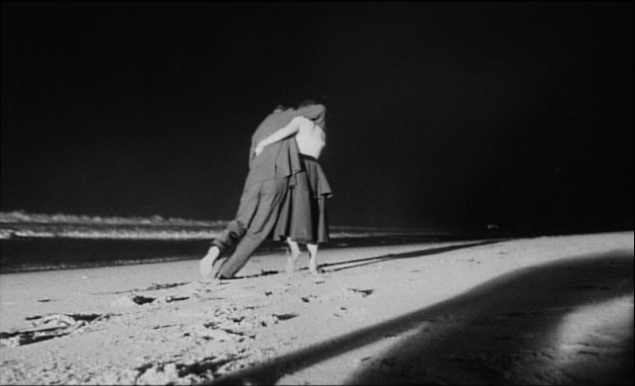


The odd halo effect.


The Explosion at this point is ridiculously prolonged. Surely an explosion of that size would have destroyed the entire house half a dozen fireballs ago.

But the after image stubbornly lingers. No matter how massive the fire the horror refuses to end.

Rarely have those words seemed more approrpriate. This looks closer to one of the closing shot of a "Big Bug" picture of the same era then it does to your final shot of a noir. They have survived, but the look on their faces is still one of horror, not relief or triumph. They have just witnessed the apocalypse after all.










 Posts


